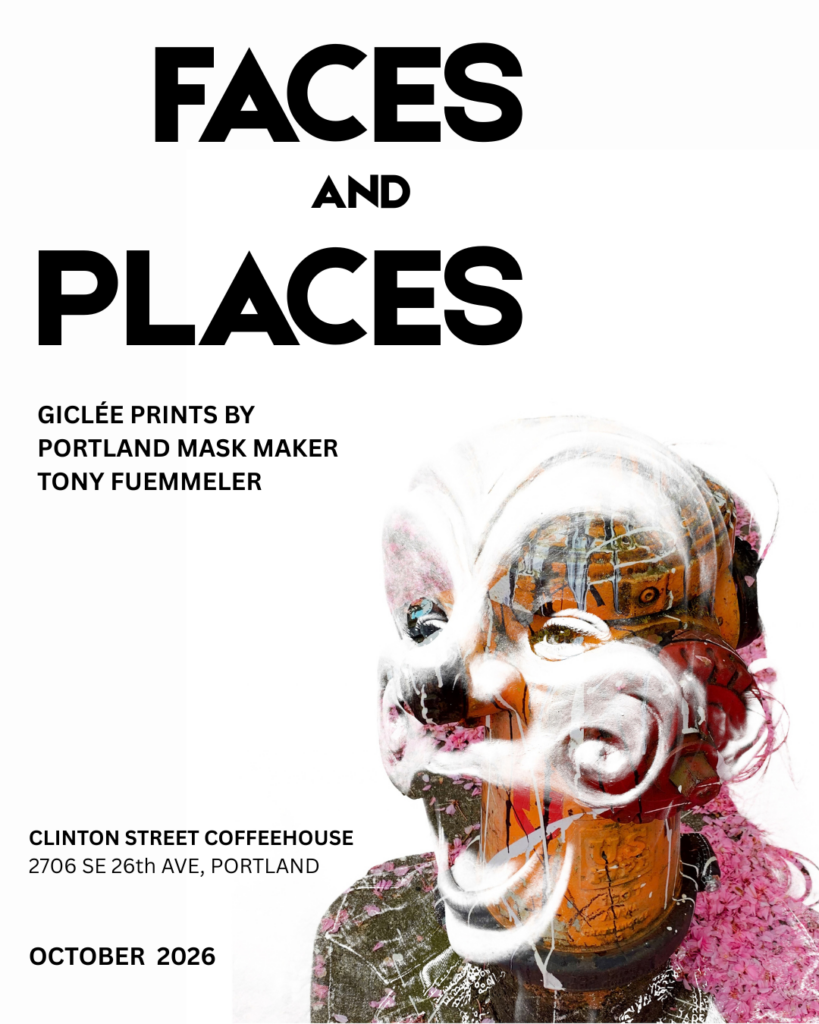
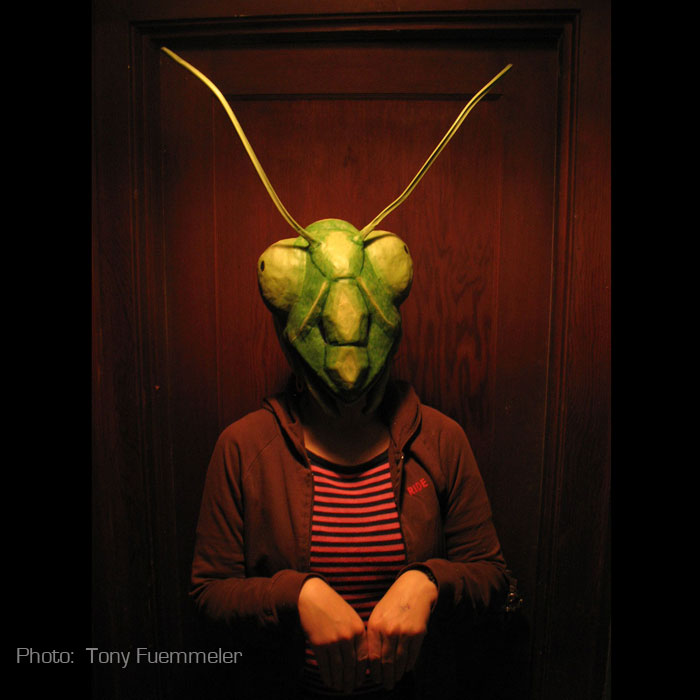
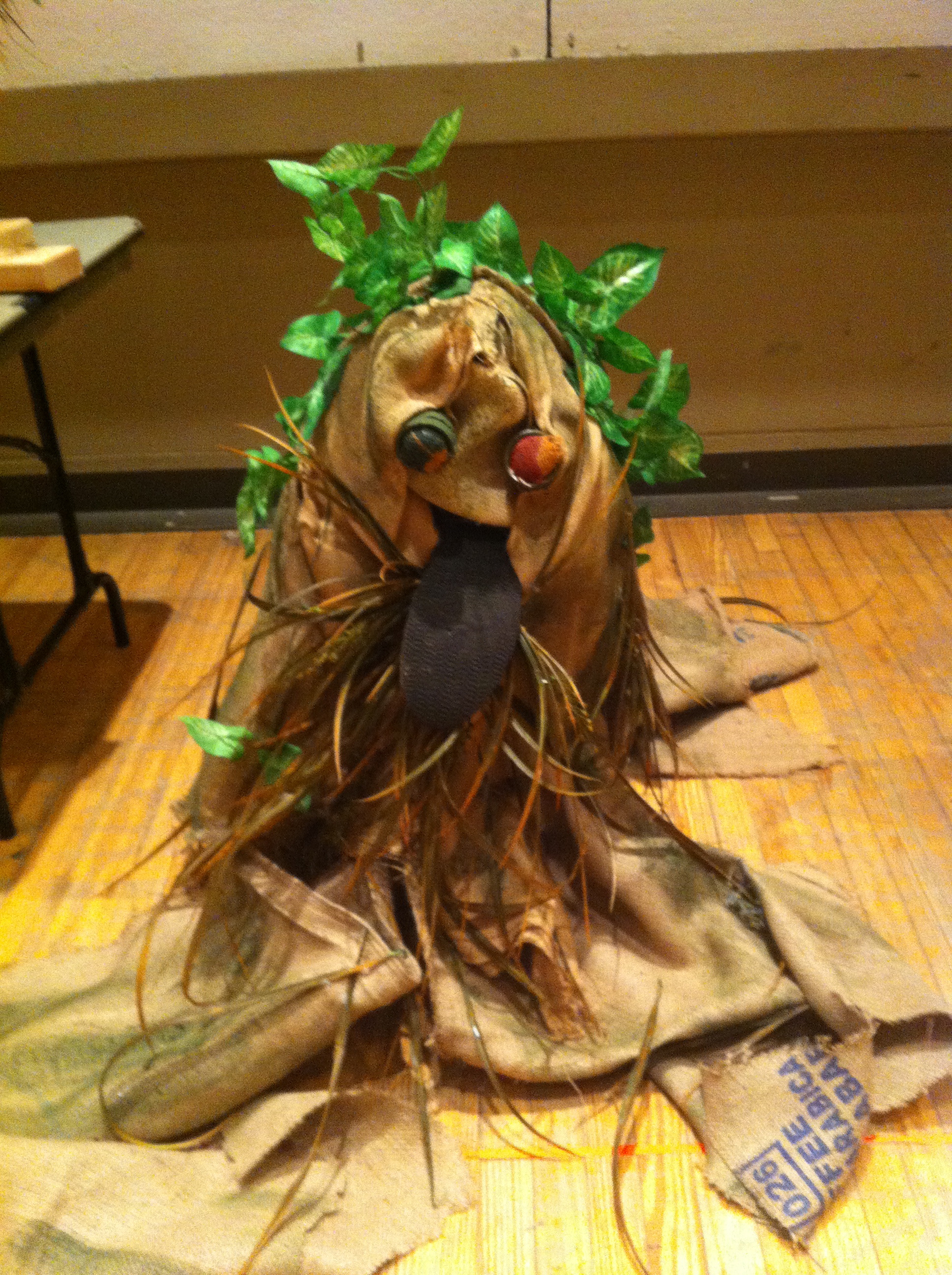
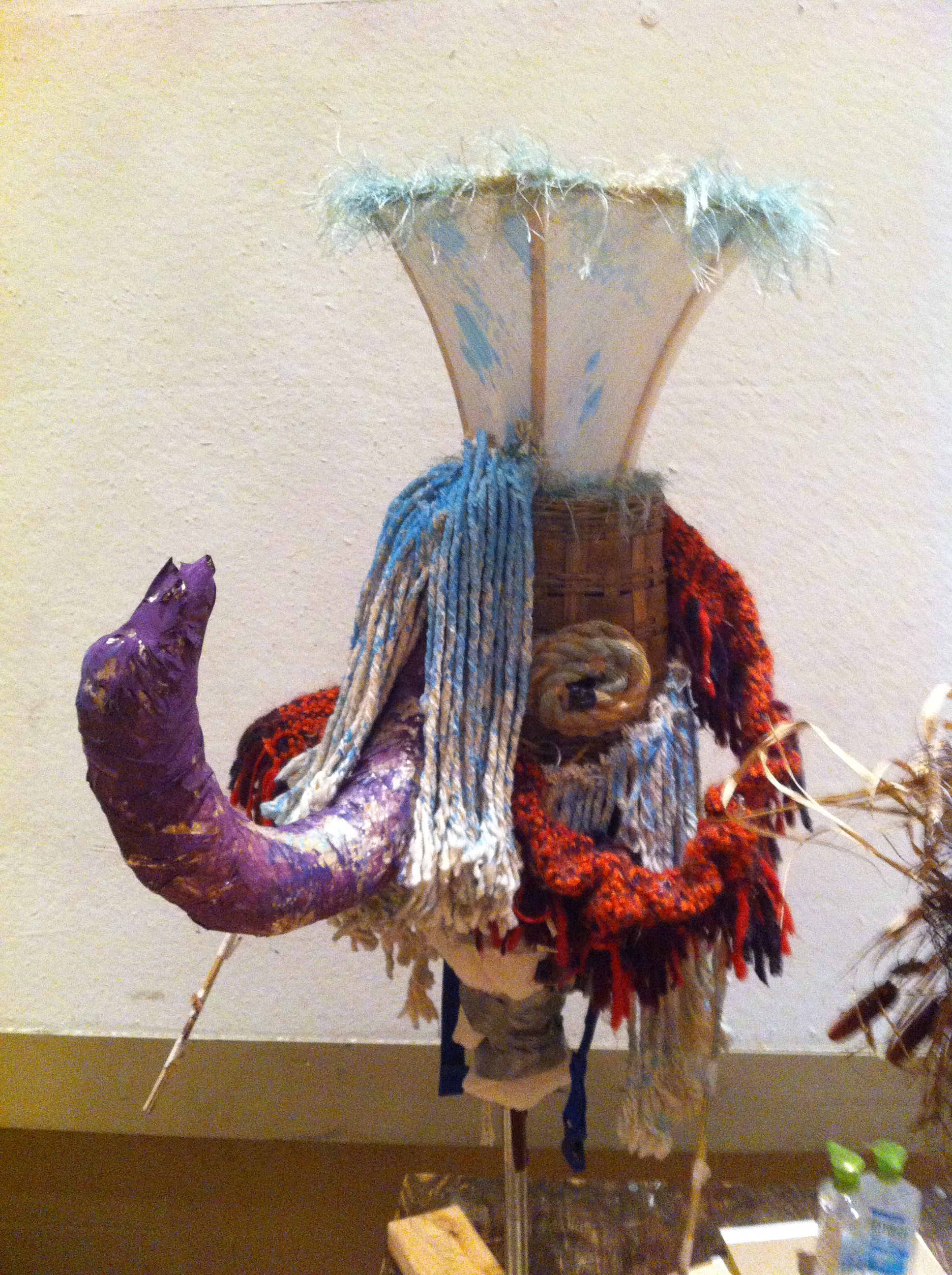
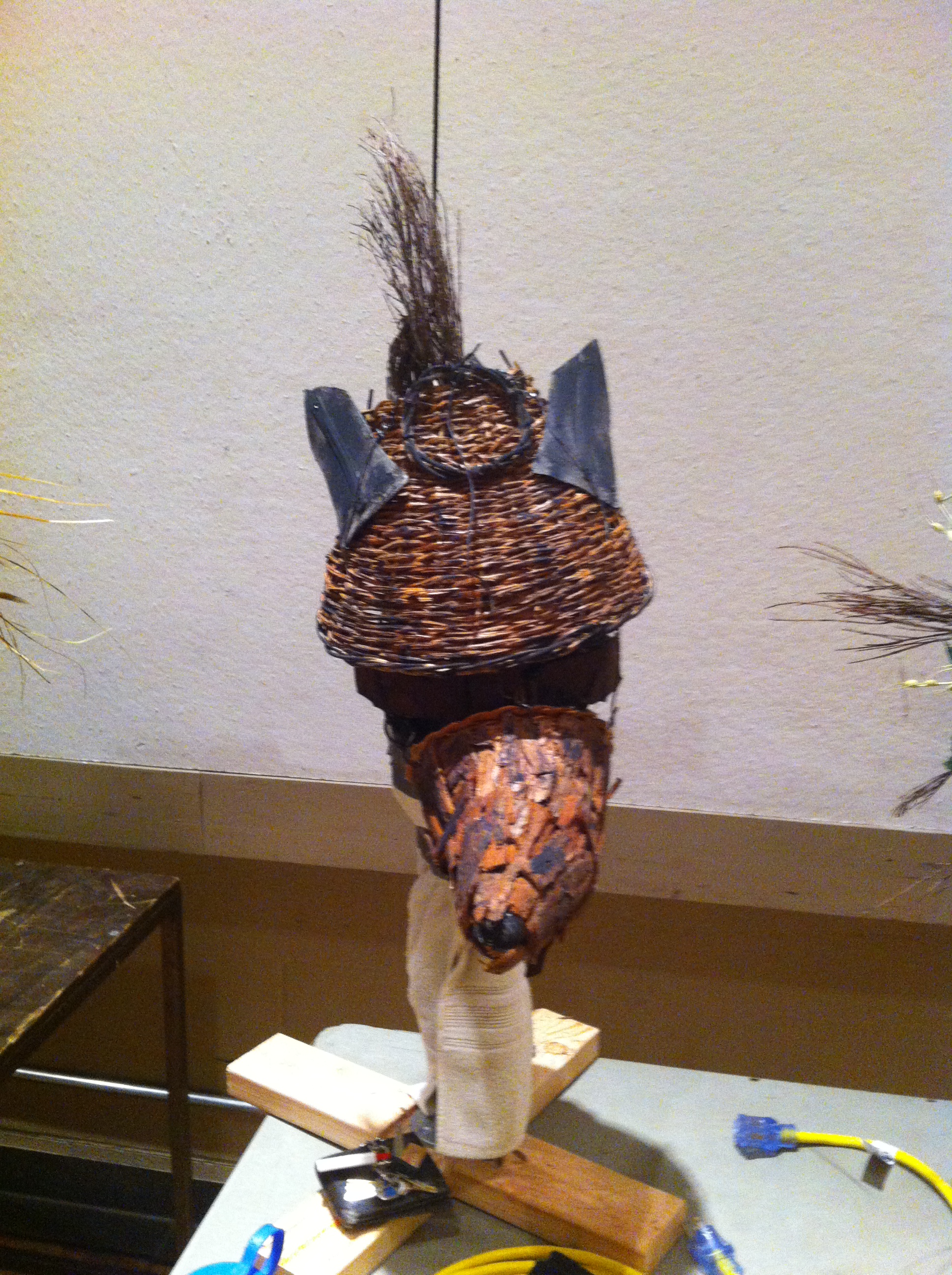
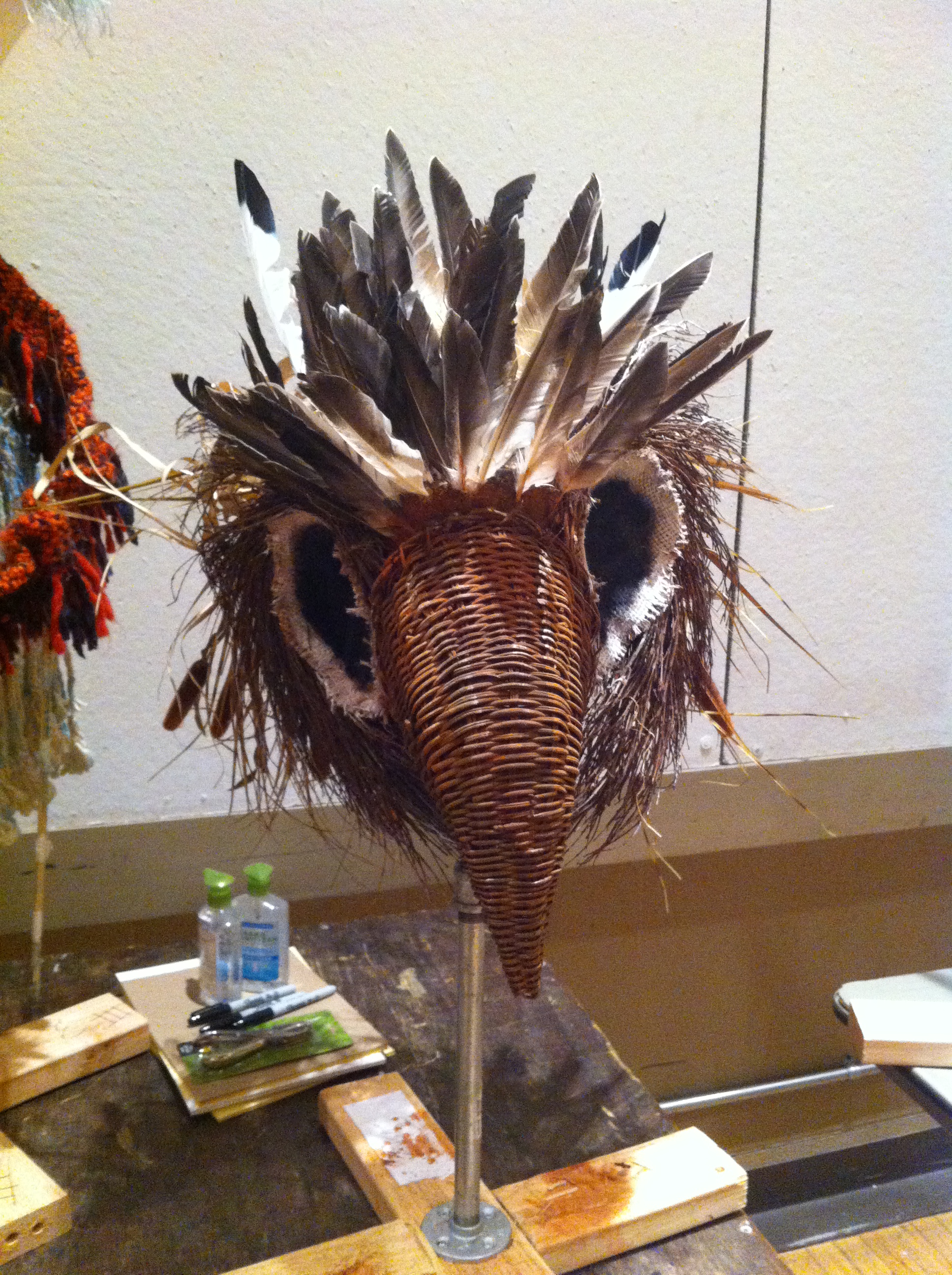
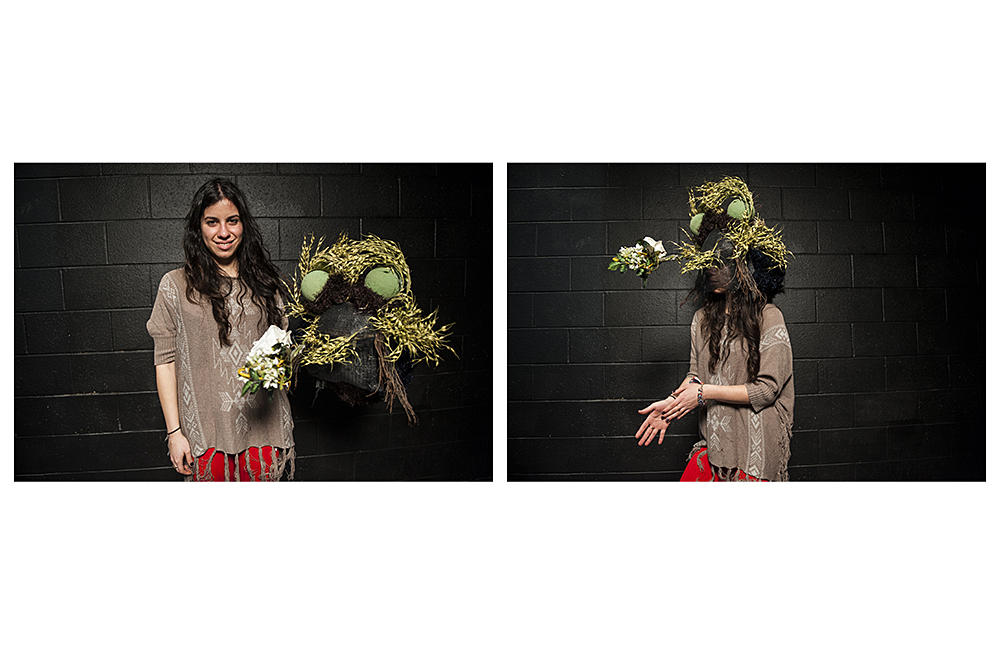
Clinton Street Coffeehouse was a spot I visited when I first moved to Portland in 2006. Now that I’m a part of the neighborhood myself, I’m excited to announce that for the month of October, I will have prints for sale at the cafe.
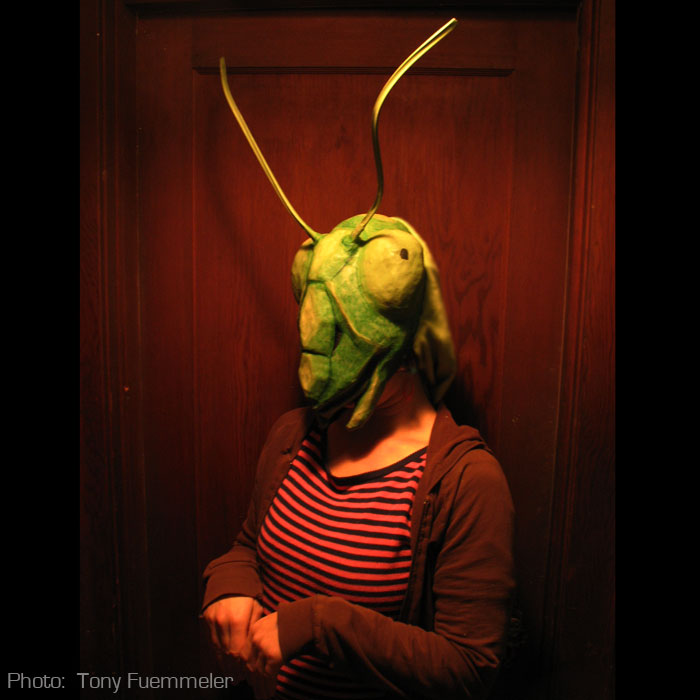
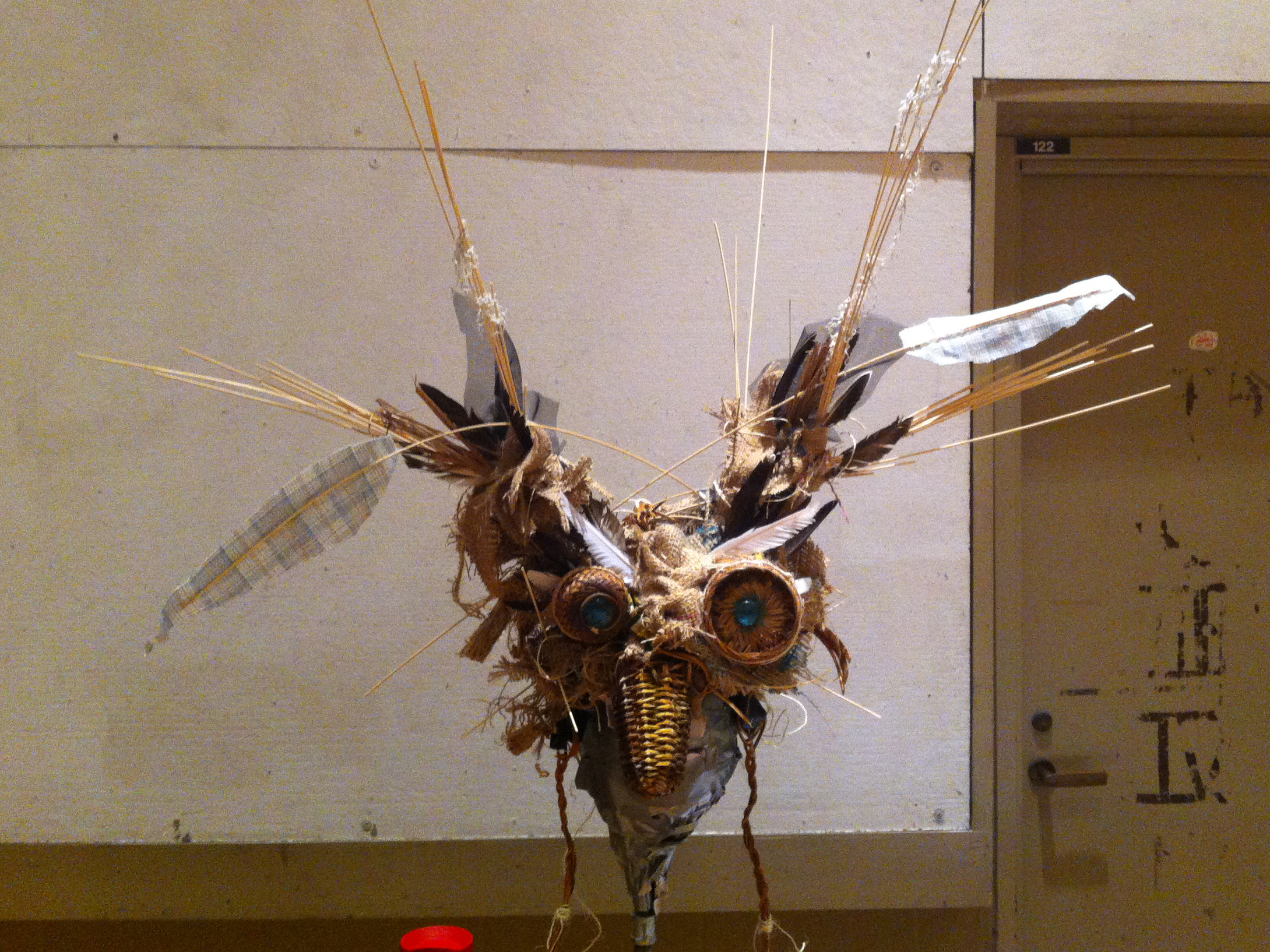
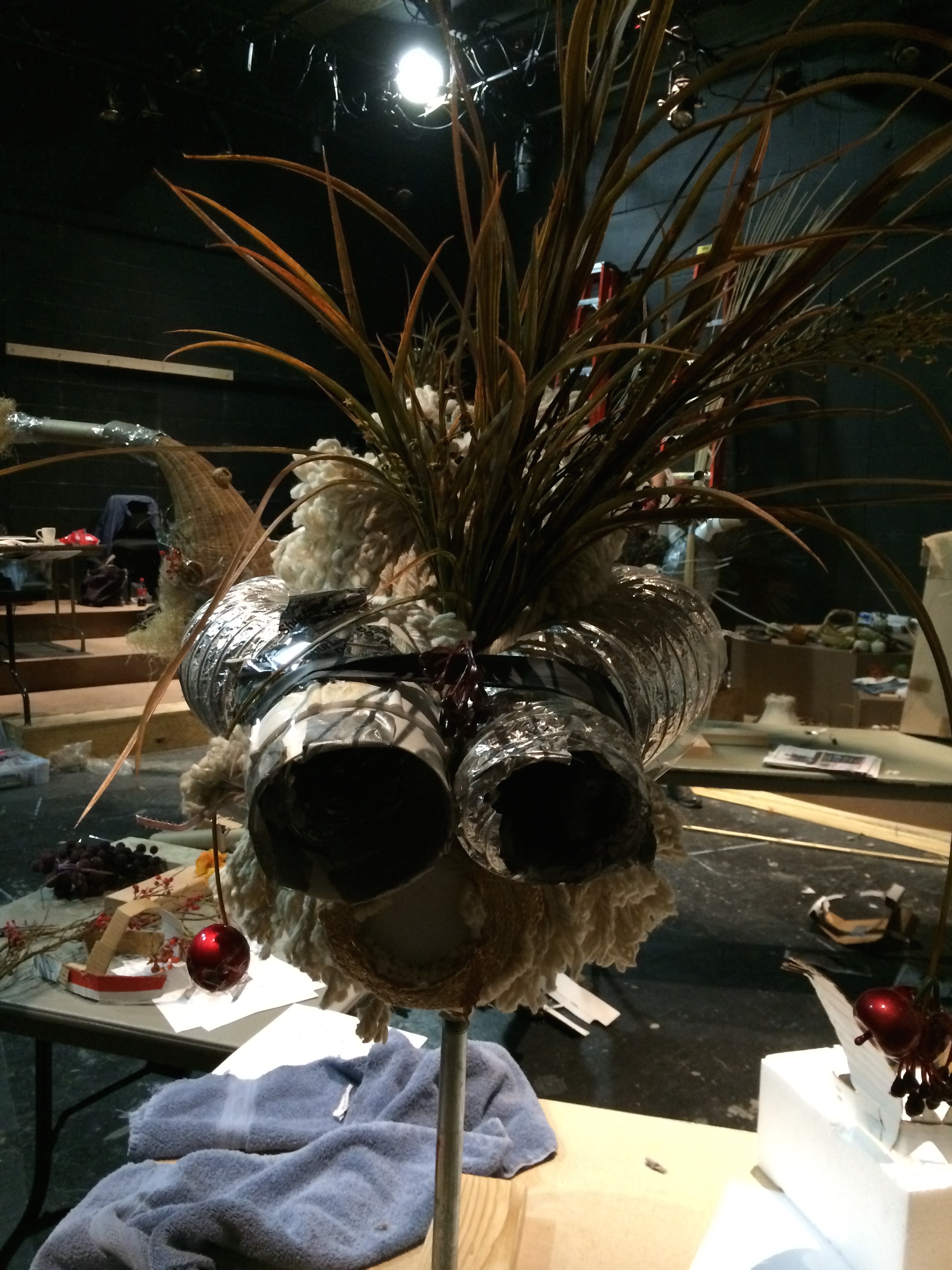
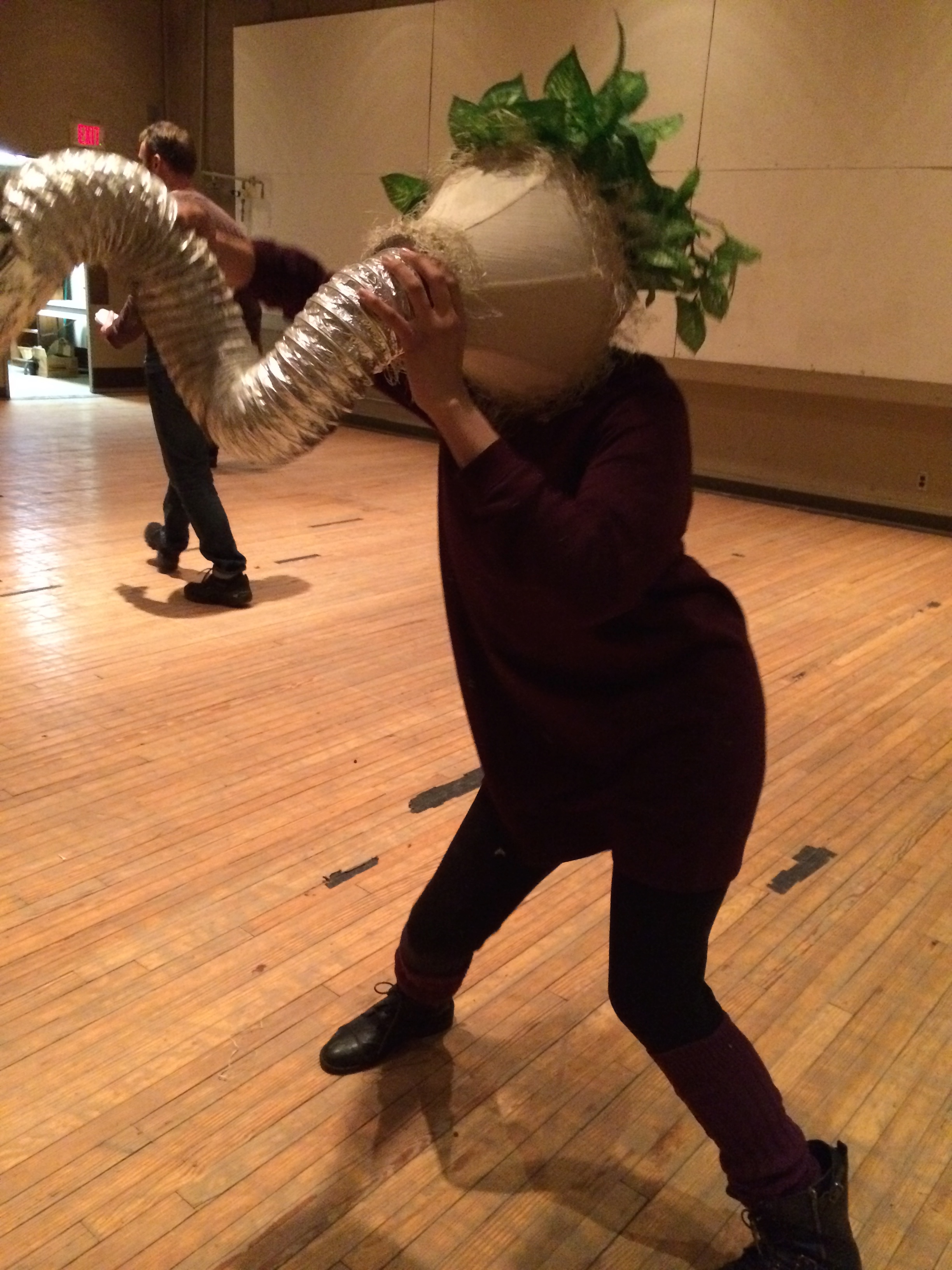
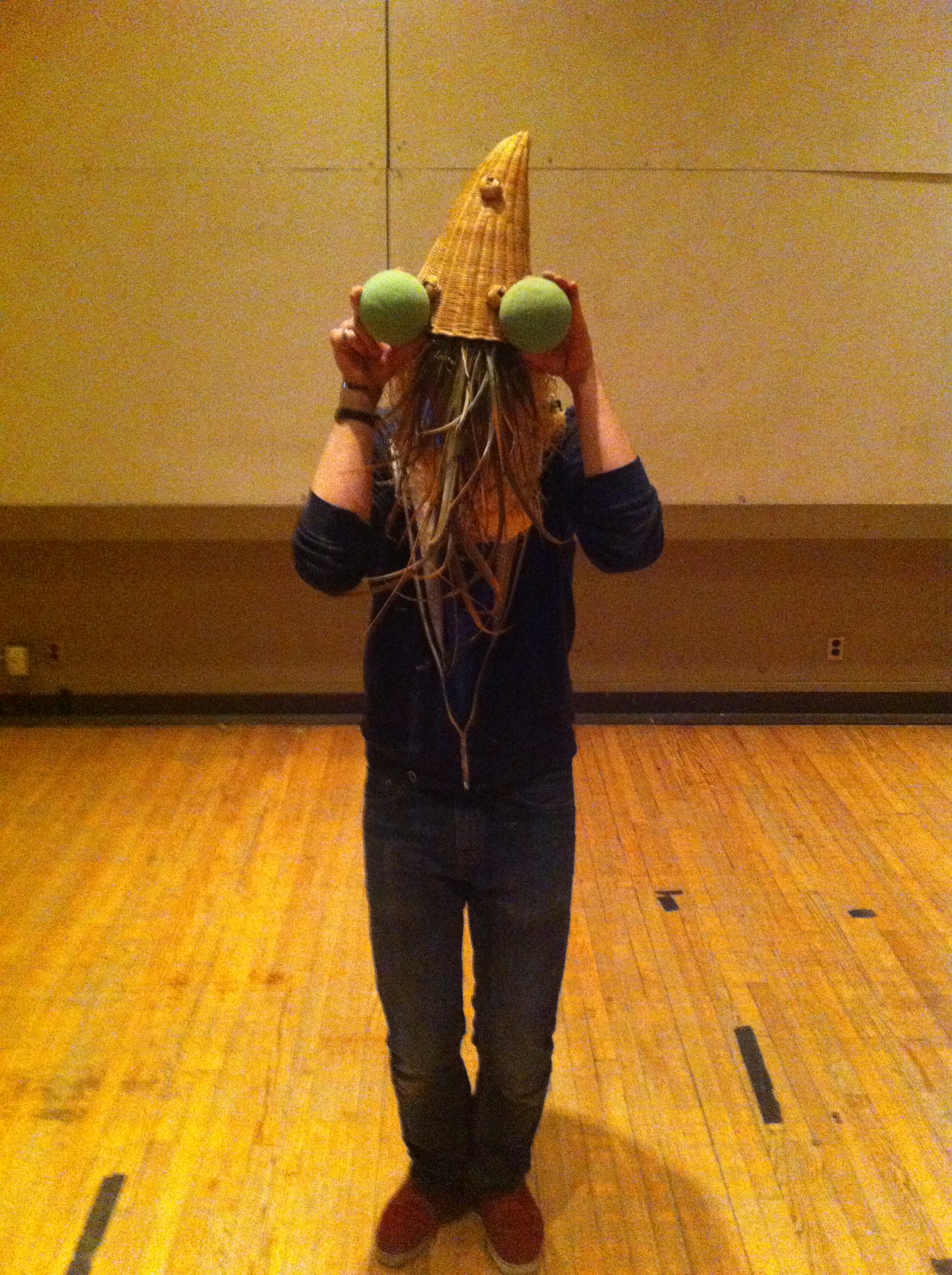
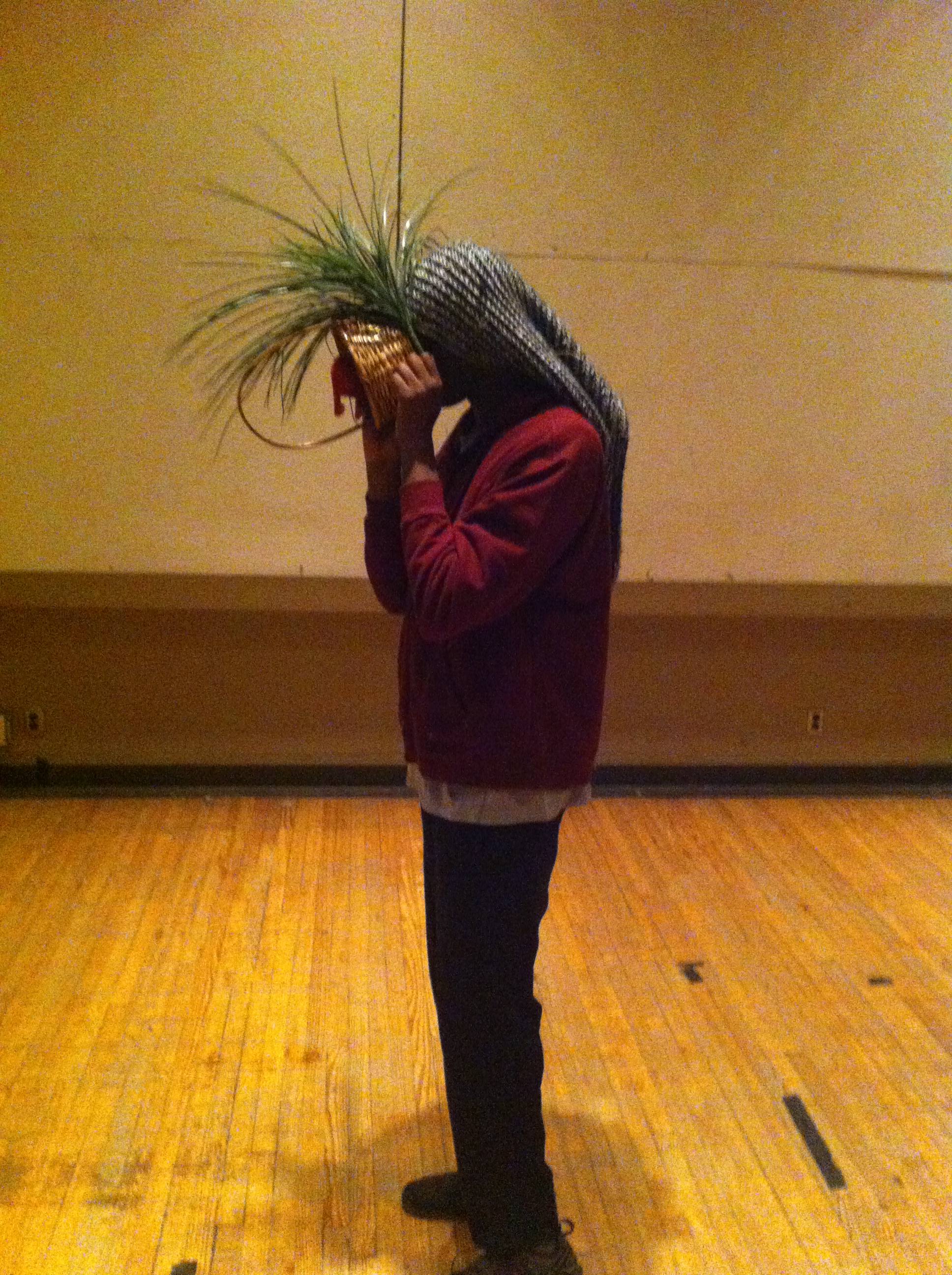
Each digital print features the juxtaposition of two images. The first is a photograph I took of a performer inhabiting a mask I created and the second photo is one I took of a locale in Portland. I overlaid the two images to find out how, when combined, the images speak to each other and bring forth a third, new story.
This image series began with a 2021 Exhibition at Arts Center East in La Grande, Oregon, called Missing Your Face. The series has expanded since then with new masks and spaces I’ve visited. Be sure to drop by and sample Clinton Street’s delicious coffee and treats and check out the work! If you’re out of town and interested in purchasing a print, send me a message.
Location: 2706 SE 26th Avenue, Portland, OR Hours: 7:00AM–4:00PM Daily for the month of October
The Spider Queen wins Best Costumes in this year’s Big Easy Awards!
This fantastical show featured 17 of my masks, amazing garments by costume designer Hope Bennett, and five puppet characters designed by Kenneth Thompson working in unison to bring a new world to life! The NOLA Project earned two other accolades on The Spider Queen—Best Original Work of Theatre (playwrights James Bartelle & Alex Martinez Wallace) and Best Actress in a Play (Becca Chapman).
Playwright James Bartelle, Costume Designer Hope Bennett, Playwright Alex Martinez Wallace, Director Jon Greene, and Puppet Designer Kenneth Thompson. Photo: Jose L. Garcia, courtesy of Gambit Weekly.
Teamwork, y’all.
It takes a special group of people to collaborate well, and the amazing director, Jon Greene know it well. We first met at my booth in the Mardi Gras Market in 2016. A little less than a year later, we began talking about how to depict classic fantasy creatures and to create characters no one had ever seen.
Masks can change the way a body moves.. so if it’s not a human body… how will it be costumed? how will human actors mix with puppet actors? Some doodles, designer discussions, and do-overs later, we were on our way.
Thanks as well to the actors who did all the (hot, sweaty) work to bring this show to life in NOMA’s Besthoff Sculpture Garden.
Old Maxpanthus and St. Allyson of the Mountain. Photo: Leslie Gamboni
The Spider Queen. Photo: Leslie Gamboni
St. Allyson of the Mountain. Photo: Leslie Gamboni
A song at sunset, Photo: Leslie Gamboni
Draybeck, the dragon sorcerer. Photo: Leslie Gamboni
For two Saturdays in March, I traveled to the Lelooska Foundation in Ariel, WA, to learn more about the art of mask carving in the Pacific NW.
Chief by the fire. Photo courtesy of the Lelooska Foundation.
Yagis. Photo courtesy of the Lelooska Foundation.
Numas awake. Photo courtesy of the Lelooska Foundation.
Hox Hox. Photo courtesy of the Lelooska Foundation.
Echo by the fire. Photo courtesy of the Lelooska Foundation.
The Lelooska Foundation is home to one of the chieftainships of the Kwakwaka’wakw tribe. Many tribes in the NW have amazing mask traditions as a part of their potlatch. Every tribe has the rights to certain characters and stories which they can present at the potlatch, as well as some of their own stylistic signatures.
Materials and Tools
Tsungani begins a deer mask with his adz.
I have long admired the transformational masks of the NW Coast peoples, and I was interested to learn more about the kinds of wood used for masks, and the tools used to make them. This type of mask very often includes a mask-within-a-mask which is revealed when the dancer activates the hinge mechanism to open the outer mask.
The workshop was attended mostly by woodworkers and carvers. I have only worked in wood a very little, and it became clear what an intimate connection to material a dedicated carver has. You must have a great understanding of how red cedar or alder behave, when they are best to harvest, ready to carve, etc.
Through my studies of mask making, another thing becomes clear. While there are some tools one can purchase commercially, every dedicated artisan eventually develops and/or refines tools which are uniquely theirs. And sometimes one makes custom versions of existing tools.
Elbow adz made of adapted double ax blade and vine maple handle.
Adz handles in waiting.
Crooked knives. Notice the bevel in the center.
The adze is a crucial tool for blocking in the rough shape. Crooked knives—as well as straight knives and chisels—refine the form of the mask.
It was cool to see these, especially as it reminded me so much of the tools I had used in Bali!
Balinese hatchet used for rough cuts.
Balinese hatchet, side view. The blade is purposefully angled.
Crooked knife from Bali.
Masks
There are a number of styles of masks utilized by the peoples of the NW Coast. In addition to the transformation masks, there are are also forehead helmet masks, halo masks, and other masks with moving parts (almost like a puppet!), etc. These photos give a just at tiny peek in the large range of the amazing masks of the Kwakwaka’wakw.
The visibility for the performer is rarely as direct as you might find in a Halloween or Mardi Gras mask. The performer may have a very limited view or none at all. It takes a very skilled performer to dance them.
See for yourself!
Chief Tsungani is a wonderful storyteller, artist, and historian, and I urge any one curious to take a workshop from him. You can also see some of their masks being danced at their Living History Performances in the spring and early summer, which I also highly recommend. (Check the link for available times.) Stop by the museum and gallery when you go.
Tsungani demonstrates rough blocking with elbow adz.
I’ve often found that people aren’t quite sure what I mean when I say I’m a mask maker. Chris Hatcher of Field Guide Films gives a terrific peek behind the curtains in this video.
Earlier this summer, I posted about my study with the Sartori in Abano Terme, a small city of 19,000 near the larger city of Padova. Here are a few photos of the rest of that work!
From our initial designs on paper, we sculpted our masks in clay. Then we made a mold, did a test run in carta pesta (an Italian papier mache), and made modifications as necessary. We then used all of our research to sculpt the wooden matrix, which was used as the base to shape our leather. This entire process took a month. It’s such a wonderful experience to be able to take the time to concentrate on a project like this without other pressures.
After finishing the masks, we met with Giorgio Bongiovanni of the Piccolo Teatro di Milano to investigate the performance of commedia masks, and later, our own. Fabian Gysling of Ècole Gysling was also there to help us find our characters and play in the masks. The slideshow above is from the public demonstration of our work. Luckily, the theater was air-conditioned.
A Two Week Interval
After completing the Sartori workshop at the CMSG, I had a little time to kill before my next workshop. I spent an extra day sketching masks at the Museo Internazionale della Maschera Amleto e Donato Sartori in Abano Terme. Next, I went to a farmhouse in Chiesanuova to visit my classmate Barbara, and together we traveled to San Miniato to visit mask maker Matteo Destro. Afterwards I traveled north to Malcesine, where I visited costume designer Fabio Toblini. I regrouped with friends to see Marmolada in the Dolomiti mountain range (a UNESCO World Heritage site). Finally, I explored historic Roma. It wasn’t built in a day, and you certainly can’t see it in three (especially in the summer heat). However, I was able to strategize a tour of Caravaggio paintings and some awesome historic buildings (e.g. the Basilica San Clemente) with the kind help of the friends and family of a fellow Portlander! (Molte grazie a Arturo, Anna, Riccardo, Guya, and Francesco!)
Here’s a slideshow sampler of my travels!
Galluzzo, Toscana, from the bus
Visiting Barbara
The farmhouse in Chiesanuova
Action shot
Abandoned art studio
A moto in San Miniato
From the train station at Peschiera, the bus takes about 80 minutes to reach Malcesine
A shot from the bus along the lakeside
Malcesine moonlight
Fabio gives me a tour of the castello.
Mountains girding Lago di Garda, the deepest in Italy.
Terra cotta roofs.
Beachfront.
Me at the lake.
Lago di Garda was a strategic spot.
Malcesine
Lago di Garda
Playing at the beach.
The road to Marmolada.
The first sight of mountains.
Coffee stop
Lunch break with selfie stick
Serrai di Sottoguda
Cooling off in the gorge
Richard + Waterfall
Tyrol: a blend of Italy & Austria
Serauta: Two gondola cars up from the ground
Military cave from WWI
Dolomiti
Dolomiti + Richard
Serauta
Alpaca
Serauta
Sassolungo
Alleghe
Alleghe
Alleghe
The train ride to Roma, just in the nick of time.
Paintings on the tracks
So many winged skulls in Roman churches.
Via di Ripetta
Fontana di Trevi
Fontana di Trevi
Piazza del Popolo
Corso del Rinascimento
Piazza Navona
The Pantheon
Sainted in the Pantheon
I took a self guided tour of Caravaggio paintings in Roma.
“Aeneas, Anchises, and Ascanius” by Gian Lorenzo Bernini
Villa Borghese
Villa Borghese
Detail of a structure in Villa Borghese
View from Passeggiata del Pincio
Gelateria Fata Morgana
Cono con due gusti
The Colosseo – named for the large statue of Nero that used to be just outside.
The Roman Fora
A street near the Vatican–it was starting to rain and I wanted to find a cafe.
Quartiere Flaminio
Quartiere Flaminio
Altare della Patria
Familie Flöz Sommer Akademie
My other study was a two-week course in mask performance and the creation of performance material in ensemble with the Berlin-based company Familie Flöz. Our classes were held in the Abbazia San Giusto, a refurbished monastery on the outskirts of the small town of Tuscania. When I told people in Italy where I was going, they (reasonably) assumed I was mispronouncing “Toscana” (aka the large region we call “Tuscany”). It only confuses the matter that Tuscania is quite near the border of Toscana.
Abano Terme, in the Veneto Region
Tuscania, in the Lazio Region
Italy, In the California Region
The Familie Flöz is pretty unique. They create original, wordless, character-centered mask performances that often play in a clown-like sense of comedy. (Check out a short film of one of their first shows in 1995, and also a trailer for their show that just swept the Edinburgh Fringe off its feet). I was very curious to find out how they devise their work and the techniques they employ to bring these full-face masks to life.
Though some students came to study how to build masks, and others came for performance training, we all began the work together each morning with a movement class. What an amazing and perfect way to start the day! Apparently birds thought so too, because they would frequently find their way into the studio—screens on windows were rare—and take a long time to find their exit.
Courtyard of the Abbazia San Giusto
A view from the tower.
The understructures for mask making were made of flower pots.
The first meal together.
Marcel explores his character through a walk outdoors.
Evening by the pool.
Me with some of the company.
Sunset over tomato fields.
Part of the molding process utilized silicone.
The first four days were conceived as a quick introduction to all of the subjects we could study more in depth beginning on day five. Not only was it a great way to survey the kind of work we would do, it also gave us an opportunity to see which of the company members had a teaching style that worked for us. In the end, I focused on Alexander Technique & Neutral Mask, Character Building in Full Face Mask, and Devising & Directing Mask Theater.
We spent a lot of time both in and out of the mask as ways to approach building both characters and scenes.Character interviews, partnered movement studies, and improvisations all flipped between these two modes. Another important idea in the beginning of the work was to remove the pressure of producing something—this pressure often only stifles the breath of creativity, and the relative value of a given improvisation can be determined the day after.
Day Off! We went to Tuscania
On the way we saw the donkeys at the lavender farm
Another monastery!
Q&A night with the company. Also the night there was a fire and the electricity went out.
The mask I worked with to devise a scene with my group
Daily watermelon break!
A shy duo encounters visitors on the final night.
Curtain call for all the scenes performed on the final night of the workshop
The mask making group trying on their new creations.
We ended the workshop with a large celebration. This included masked characters walking around the grounds of the Abbey as visitors entered, followed by a number of short scenes —including the one our group created about a composer finding inspiration in his everyday surroundings. Then, of course, lots of food and dancing!
When I thought back over my experience, I thought a lot about what conditions made for my best work over the summer. None of these are necessarily surprising, but the combination of these things was important.
Doing one thing at a time
Working in community
Limiting distractions
Being in a supportive culture
Proactive learning: pursuing questions vs waiting to receive wisdom
Listening to my intuition
Daily movement practice / Intentional connection with the body
Remaining emotionally available
Exchange with other cultures
The same might be said of life in general.
Final Dance Party at Abbazia San Giusto
Many thanks ! The study with Familie Flöz was made possible in part by a professional development grant from :
This show was produced at Lewis and Clark College in Portland, OR, and designed by Professor Michael Olich. I worked as the movement consultant for the actors and as an assistant designer/ builder of various mask and puppet items.
Seven months before the show would open, we met to share broad concepts, discuss exciting opportunities, and forecast potential hurdles. At this early point, it became clear that some things needed to be tried in a rough form to solidify the approach of the design.
Parrot puppet
One such element was the parrot. The first task was to figure out from where it would be manipulated. The parrot couldn’t be designed properly without that key information.
(click on each photo to see full size and captions)
The basic concept was tested in scrap foam, construction paper, masking tape and bamboo
Testing motion with upgraded materials
Feathers were cut from craft foam to match Durandarte’s color palette
A spray bottle and styrofoam ball were the understructure.
The aim of the design was to echo the elements in the human version of the character while providing a clear sense of focus for the puppet
A second parrot (with folded wings) for the scenes after the parrot was caught.
After trying a few options, including operating it from above, the most feasible and satisfying conclusion was to puppeteer from the stage deck.
At first I thought I might have to trigger the flapping of the wings through a mechanism on the control rod, but using gravity to activate the foam wings was pretty satisfying.
Stag & Bear Masks
The show was not cast until September, so many issues of scale had to be determined at that time. To know how big to make the mask, it was better to know the size of the body supporting that mask.
I thought topographically to create the individual pattern pieces for each layer of the stag mask.
One of the early trial material was this translucent coroplast.
Actors working in rehearsal masks are great sources of information as a builder.
An early test of the rings had them suspended by thin gauge wire. Eventually we used scrim for the dual purpose of masking and connection.
The best solution for both stag and bear characters was a helmet mask—the stags were mounted on construction helmets, and the bear was, itself, a helmet.
I made trial pieces to test my construction methods.
Eventually, a bandsaw was a better solution for cutting out all the pieces. Exactos remained important for the connector slots, however.
Mask attached to helmet.
The layers of bear, from front to back.
I made this larger rehearsal mask for bear, which also allowed me try out a few different attachement methods.
The final bear used coroplast lined with metallic fabric, and scrim covered the open mouth.
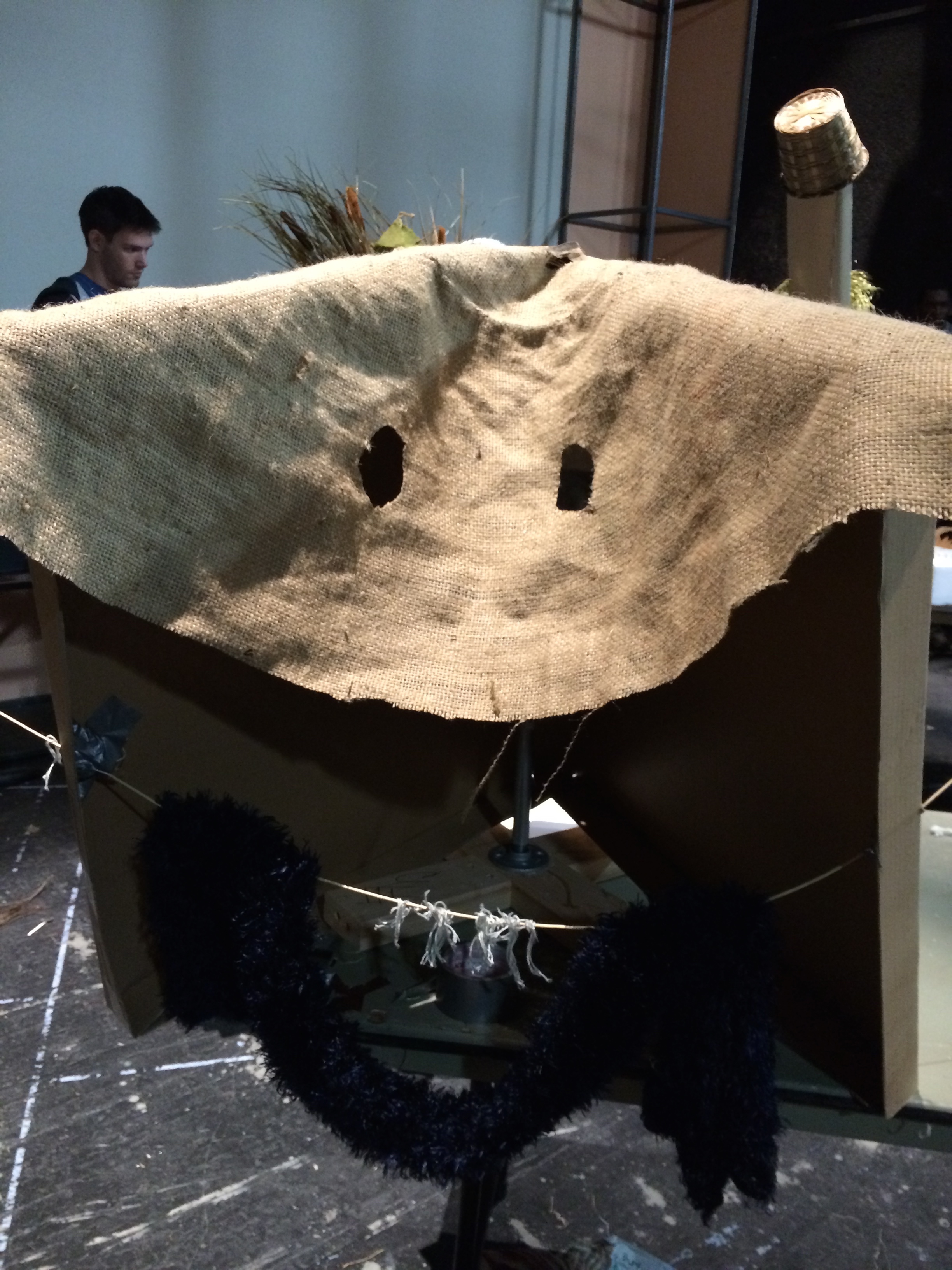
The script requires an enchanted statue that comes to life and laughs at key moments in the story. The designer had a clear idea of the look of the statue and a general sense of intended scale early in the process. Once the part was cast, I could determine measurements that would allow the actor’s face to be seen and permit her arms to reach the control mechanisms.
Strategizing internal structure
The scenery shop provided the first step , a steel ladder and on a wooden base, with two metal support ovals.
To help us all visualize, I constructed a hasty mockup in cardboard. It helped me strategize how I would eventually use the fabric-covered foam to create the cape.
My friend Bill helps by patterning the Y20 foam
Fine-tuning the contours
Anchoring the hood of the cape
The third strategy for hand construction worked. They were designed in a way parallel to “topographic” approach to the stags and bear.
Extra supports and surfaces were needed as I listened to the materials I was using.
The order of operations was difficult—and necessary—to determine, much like constructing a garment in a costume shop. The pieces were unwieldy, so it was very nice to have assistance from student workers.
Waiting backstage
Even then, it was a challenge! I was using many materials and adhesives that were relatively new to me, and doing so in a short amount of time. We would joke frequently about how every single solution created two new problems. It was a relief to have the advice and help of both my friends in the puppetry community and also my collaborators on the show as I learned about making this statue.
It’s amazing to me how much expression can be manifested with just a few movements. The only movements available to the actor were the flex in the statue’s hands and those of her own face, but she was able to find great levels and variety to play.
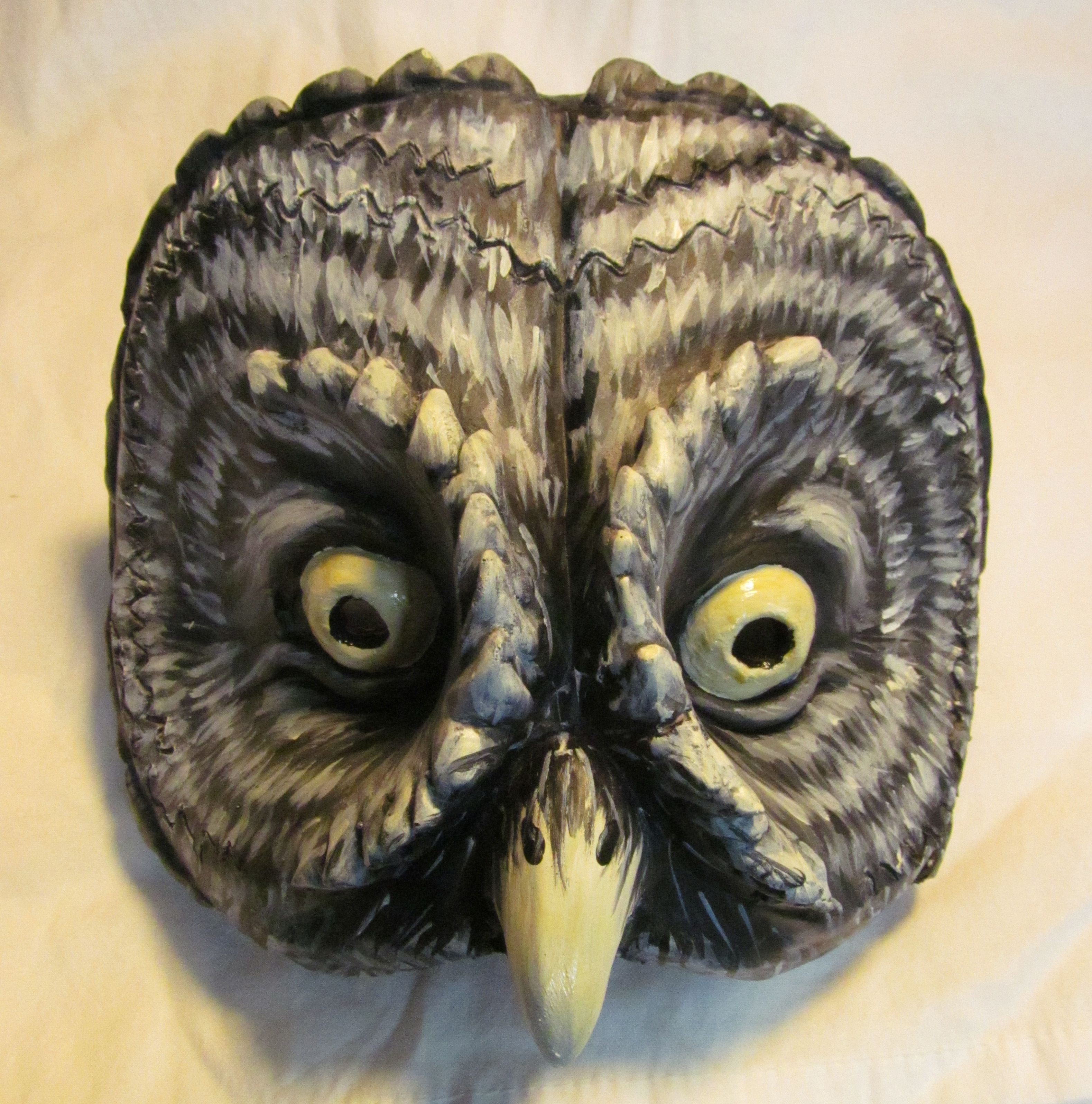
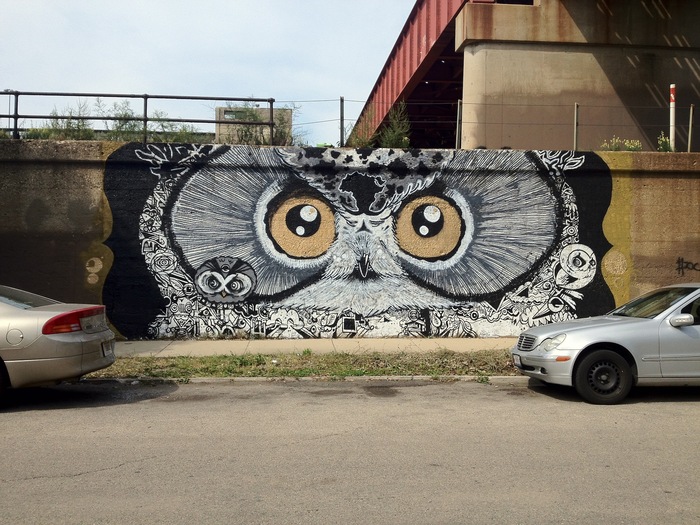
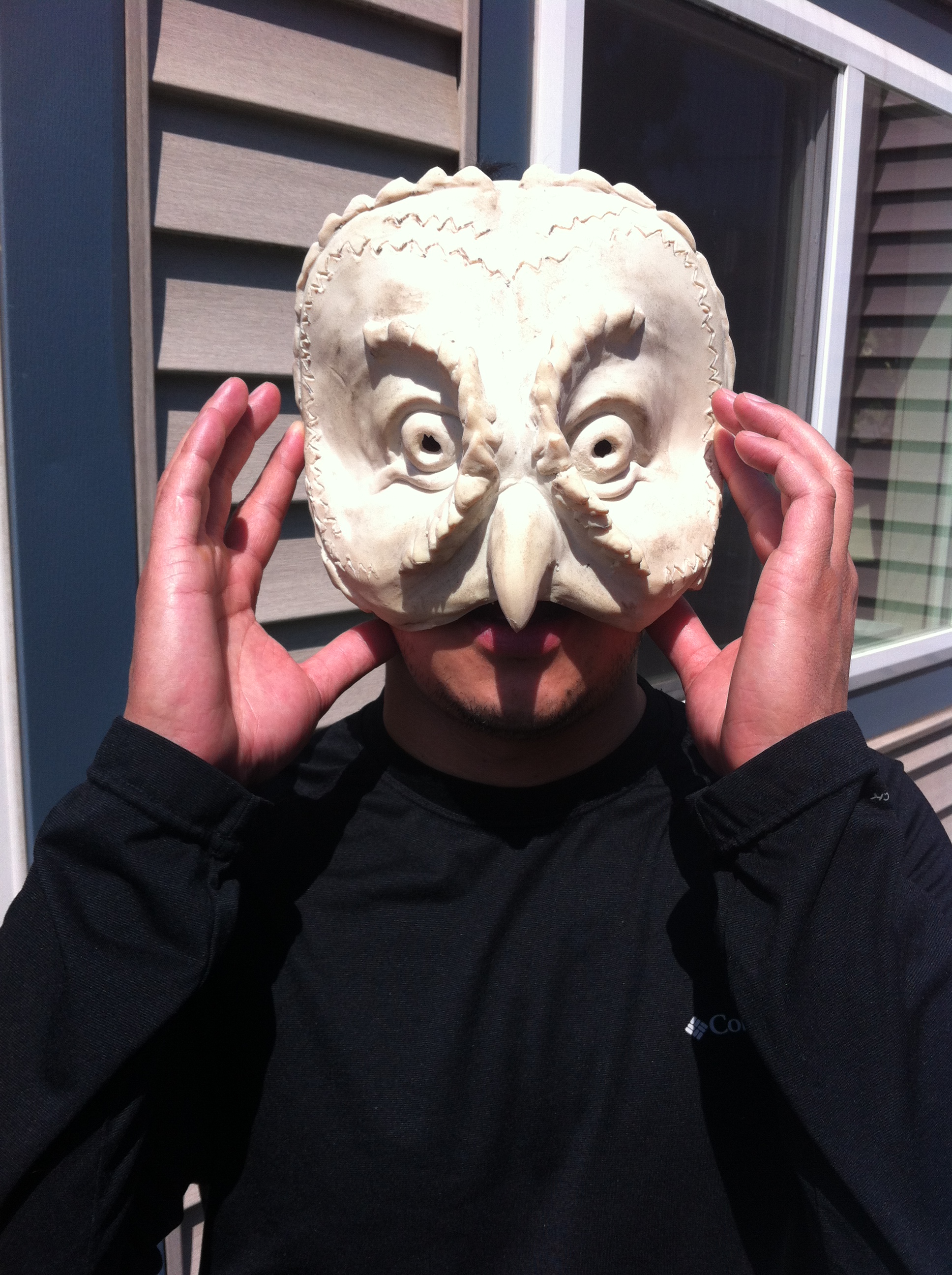
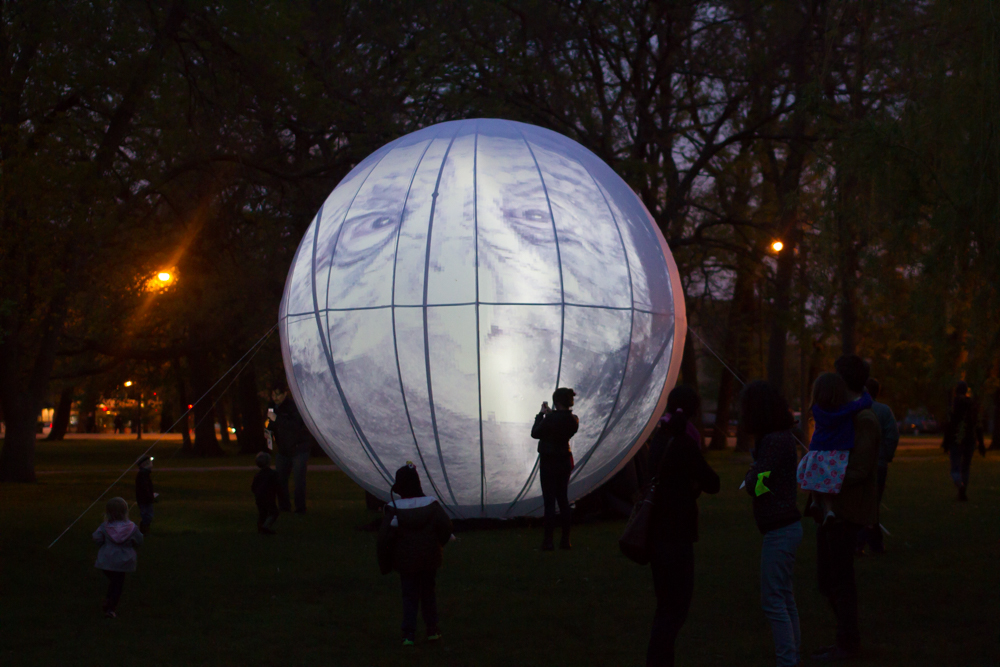
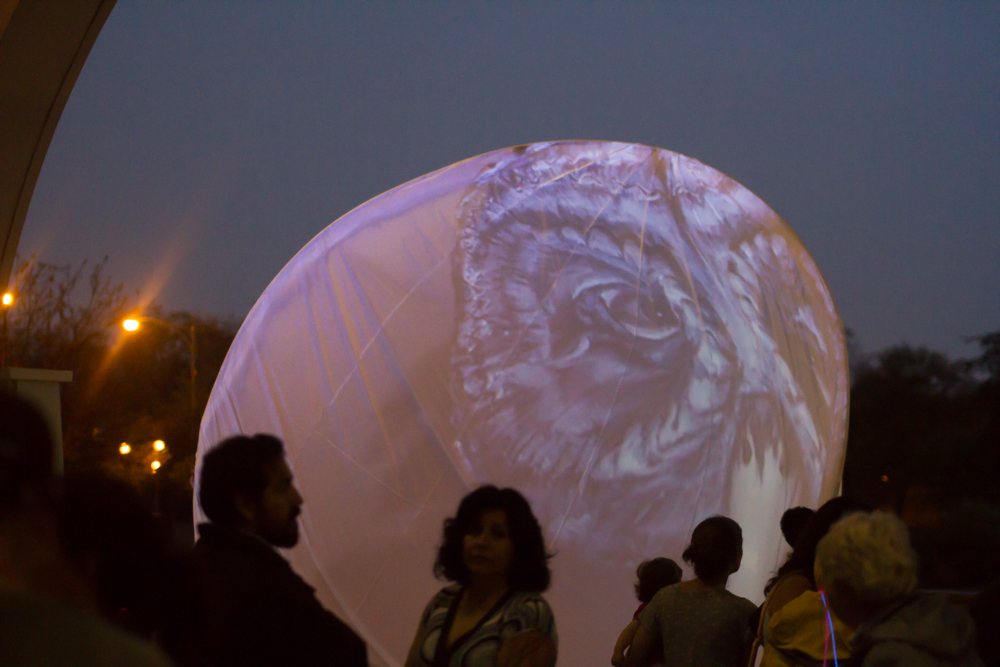
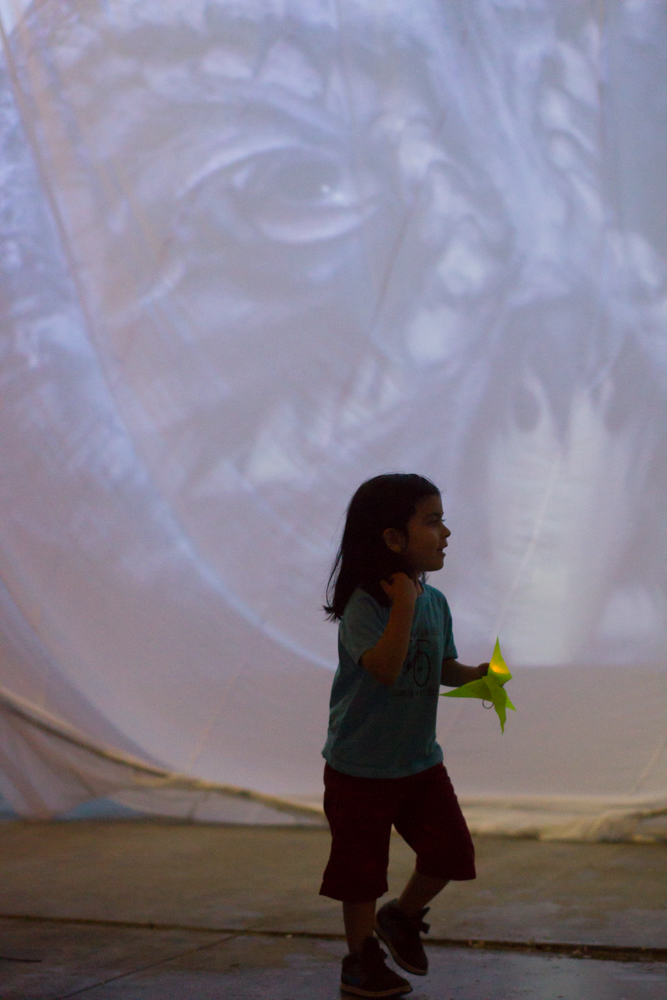
Opera-matic, a collaborative arts group in Chicago, contacted me this last spring to make a mask for The Moon on the Lagoon, The community performance featured lullabies and the faces people find in the moon. What a cool idea!
I was sent this image by a group in Chicago commissioning an owl mask.
Part of designing the mask is figuring how it will align with and/or cover the performer’s face. The producers knew they wanted the mouth of the performer available, so I approached it much like a three-quarter character mask.
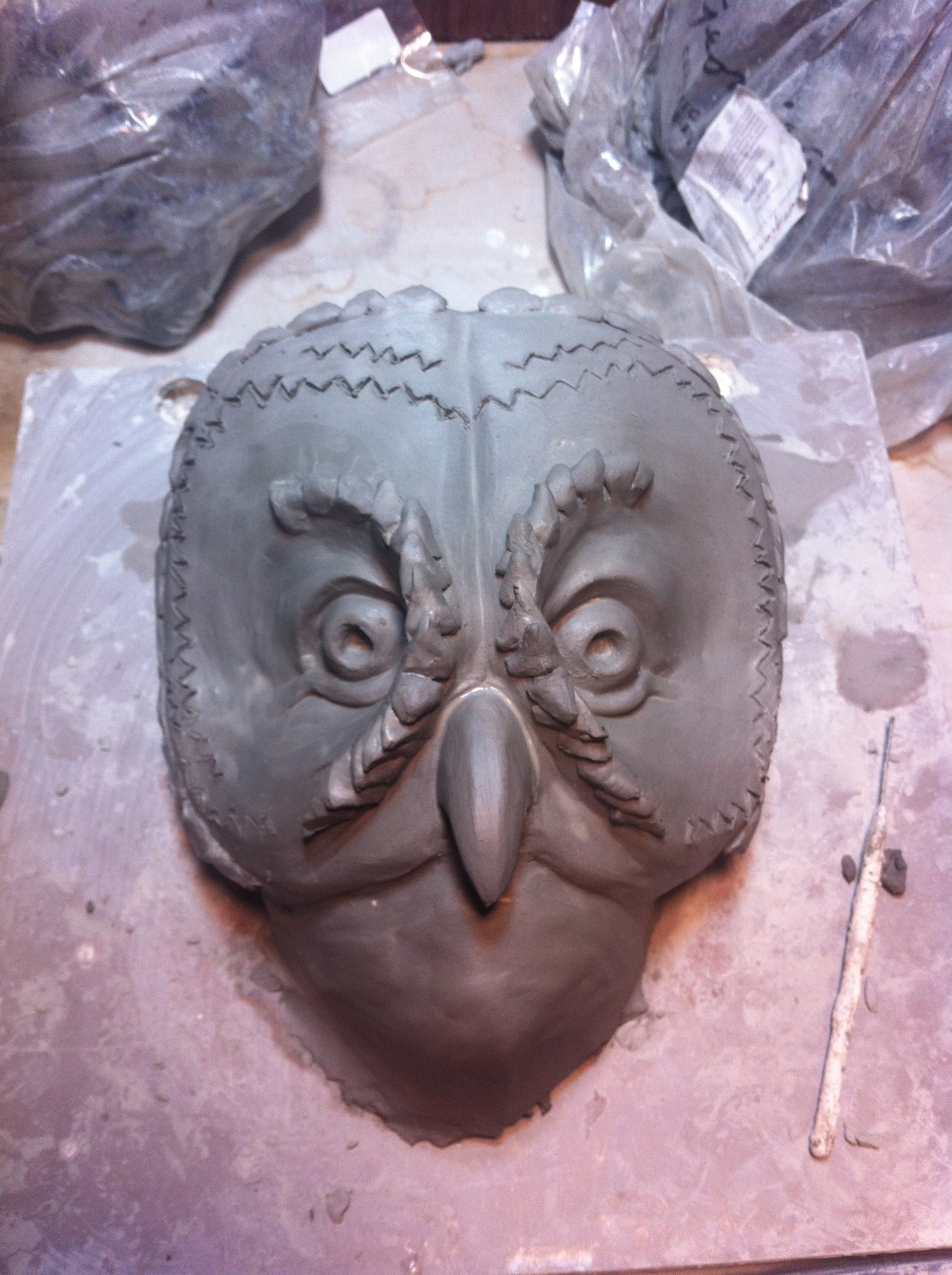
Sculpting happened quite quickly on this project because the mask was needed quickly.
I knew the image of the performer in the mask would be projected onto a surface, so I wanted to be sure to include various amounts of relief in the sculpture.
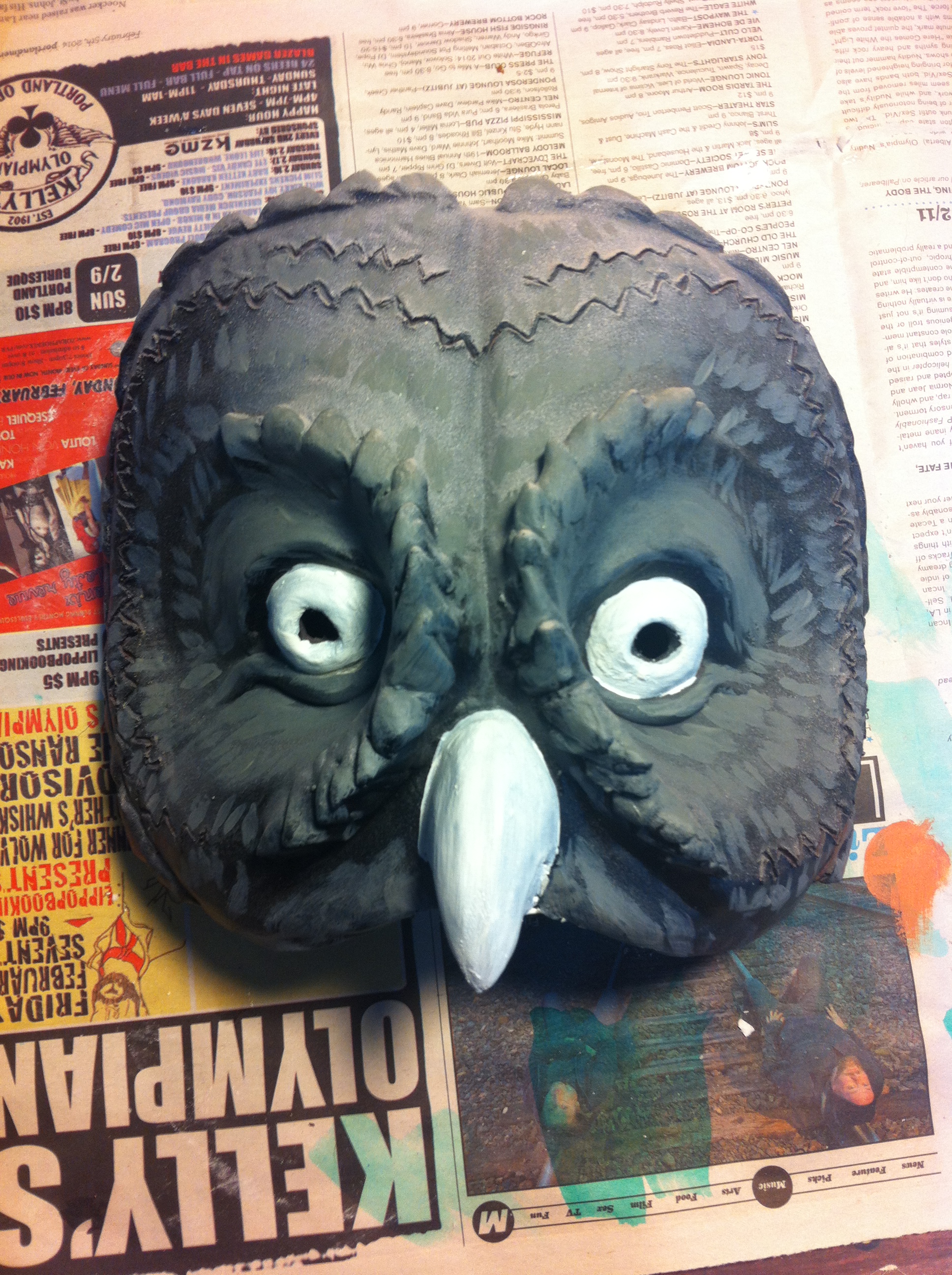
For this project, I used an underpainting technique for highlight and shadow. I started adding tones for the feathers after.
The initial painting treatment. Though I liked it by the light of day, it seemed like it might be too dark for the context in which it would be performed.
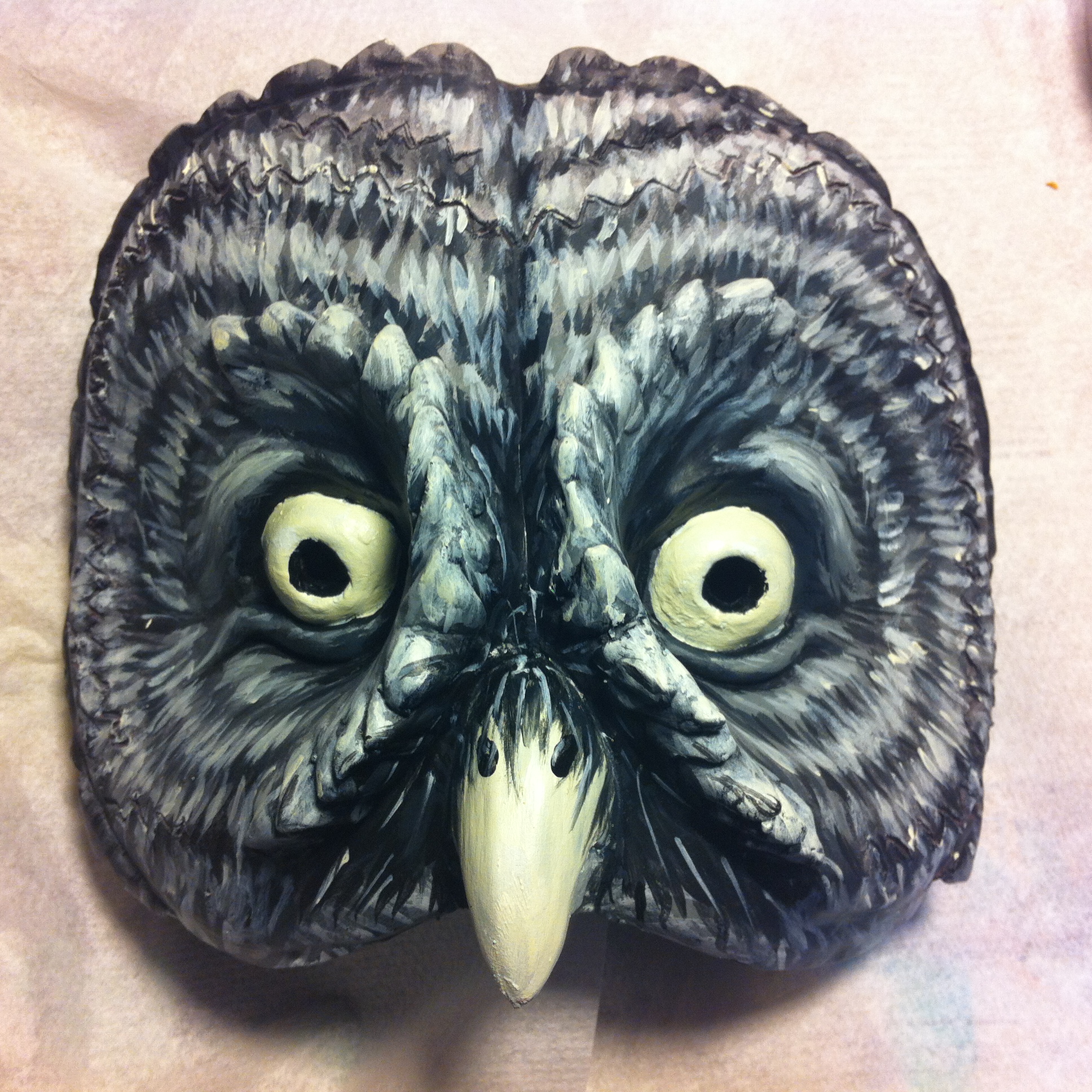
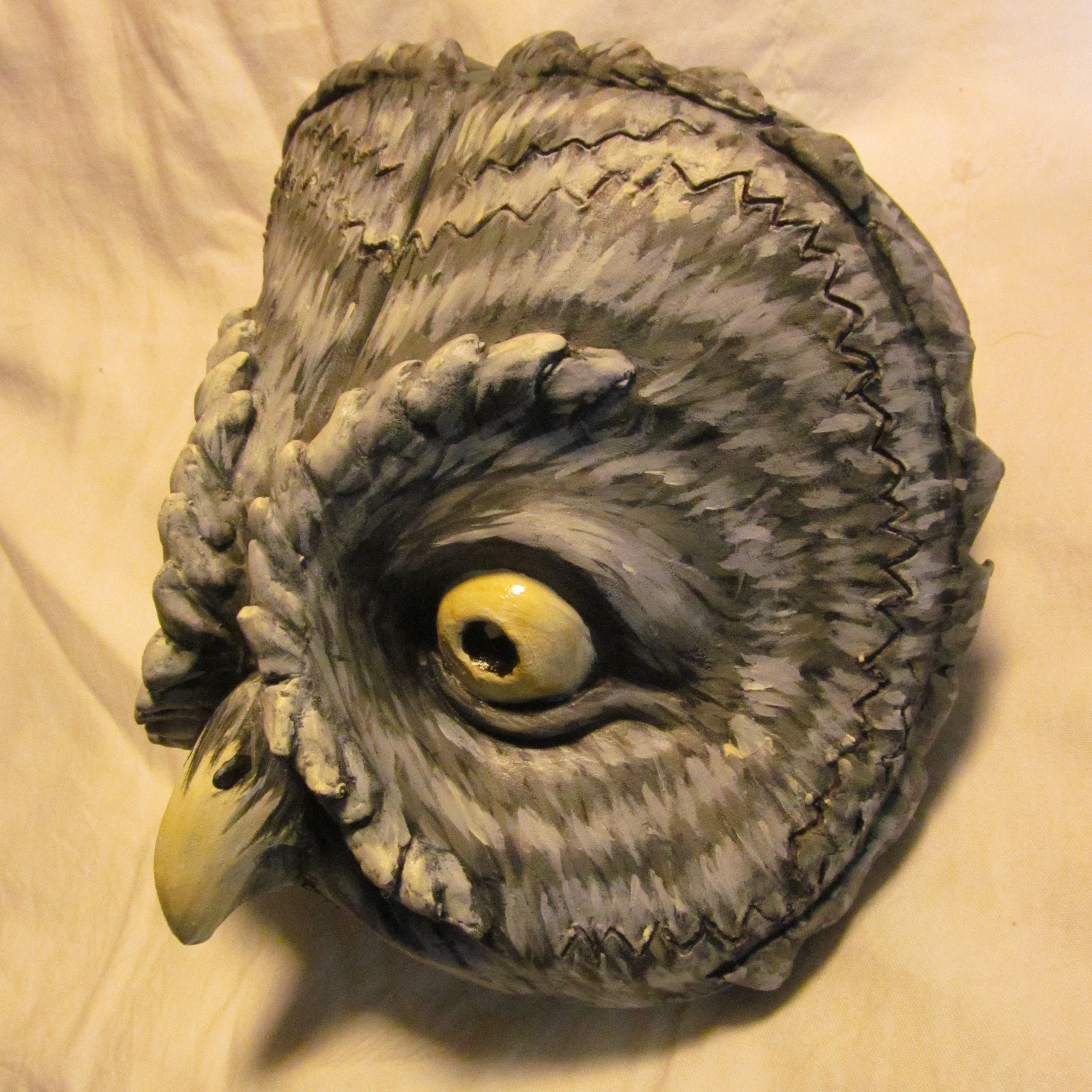
Luckily, the idea of underpainting continued as I lightened the tone with additional layers of feathers. It ended looking nice and complex.
Inspiration and discovery continue throughout the process of making. Those moments are my favorite in my process. These inspirations can manifest in an accident, through a coincidence of timing, etc.
The first version of this mask was made for the Grand Guignolers company in Los Angeles. It was to be human in scale, which directed my choice about how to create visibility for the actor.
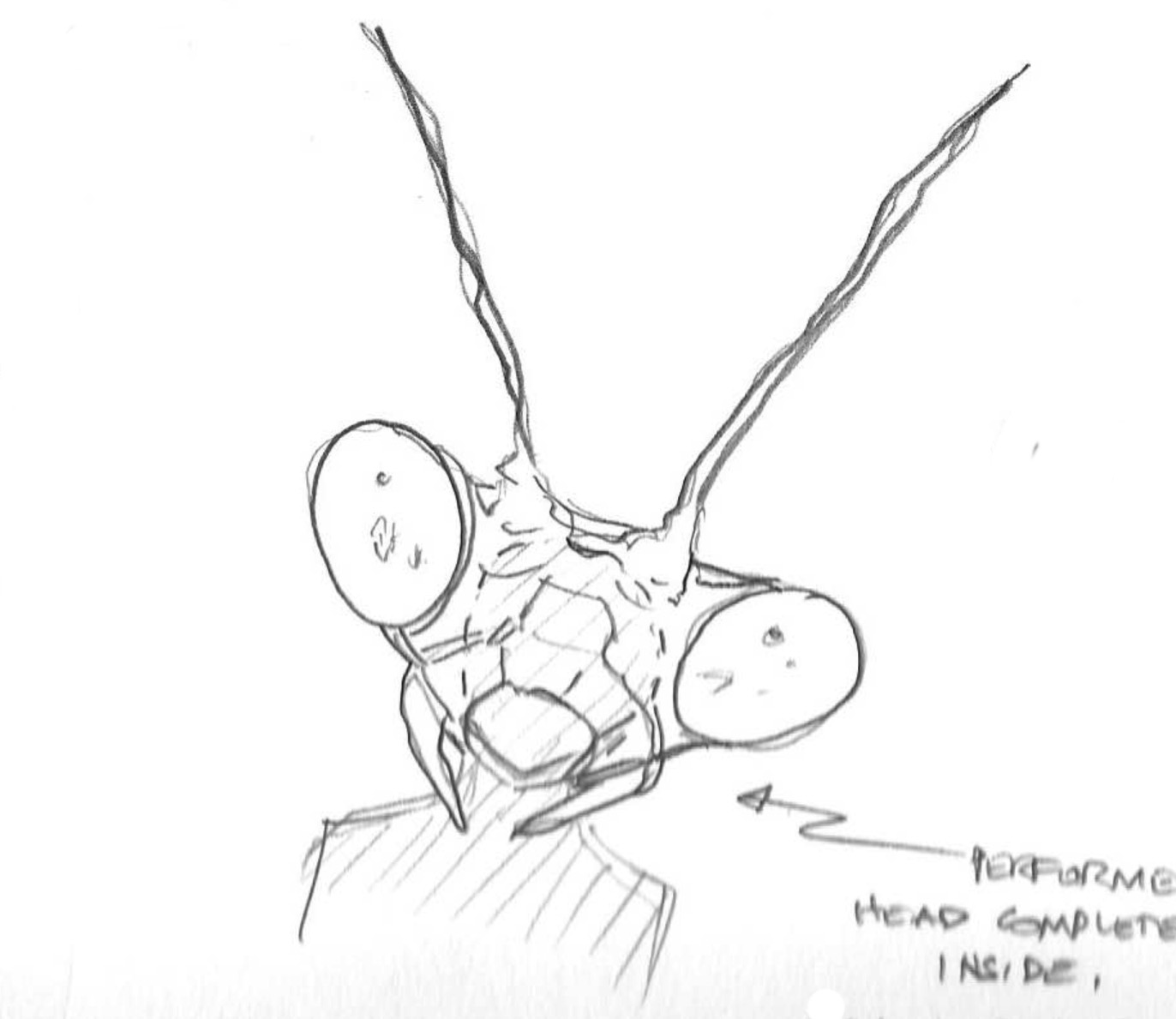
Coy. So coy. Just a like a mantis.
Though difficult to see here, the exoskeleton is textured with small brushstrokes to add life to the painting under stage lights.
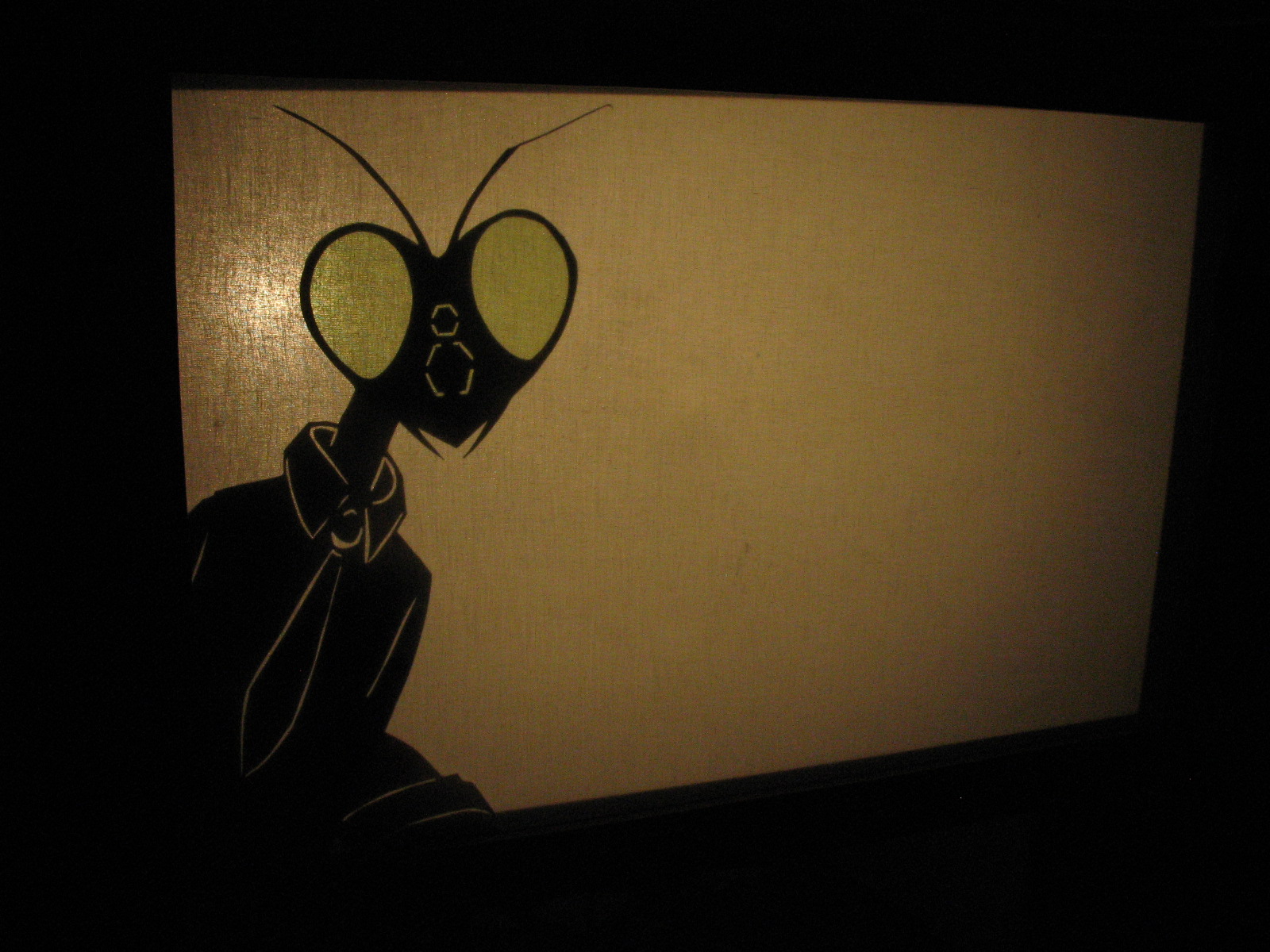
This amazing insect was so inspiring, it started appearing in other projects, like the shadow puppet show bugged, created with Rollin Carlson.
An exploratory image from the making of “bugged”—like so many images, it didn’t make it into the show.
Working in shadow encourages an essentialization of form. It’s interesting to look back and see which elements carry on and evolve through the various iterations. After this further exploration of this form through puppetry, I realized wasn’t quite satisfied with the silhouette. I jumped at the chance to improve it with my next commission for the insect.
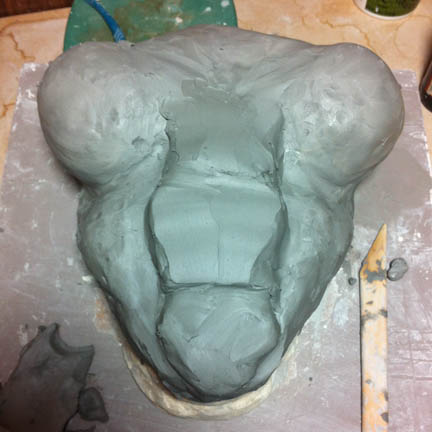
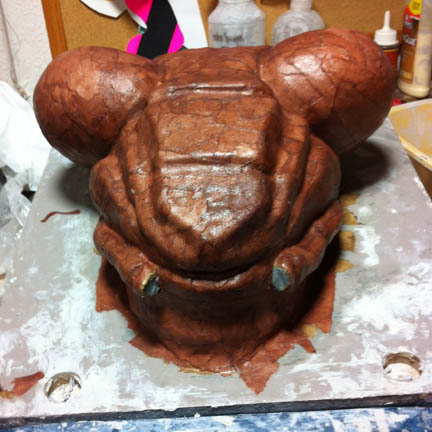
Round 2: blocking in a sculpture for a new version.
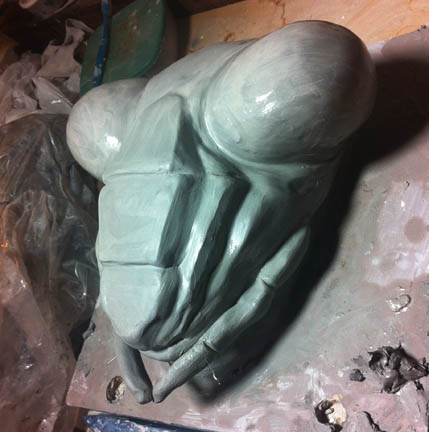
Refining the sculpture
I had to cut off part of the clay mandibles to accomplish the papier-mache. They were made separately and joined once the cast had been pulled from the clay.
This praying mantis has more texture on the eyes than the exoskeleton. It also has a special paint on the eyes to create a feeling of iridescence.
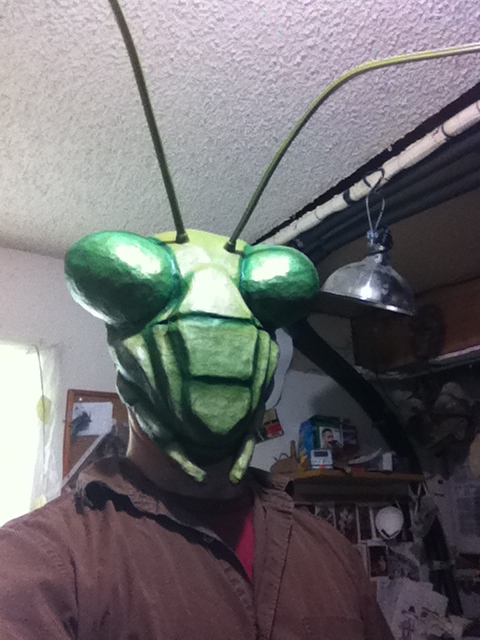
I refined the eye hole to be even more incorporated in the geometry of the sculpture. The next time I had the opportunity to work on this mask, I played around a little with color. Research images guided my thoughts.
A variation from the previous sculpture. Research provided additional ideas fro coloring. The eyes were further refined and smoothed with paper clay.
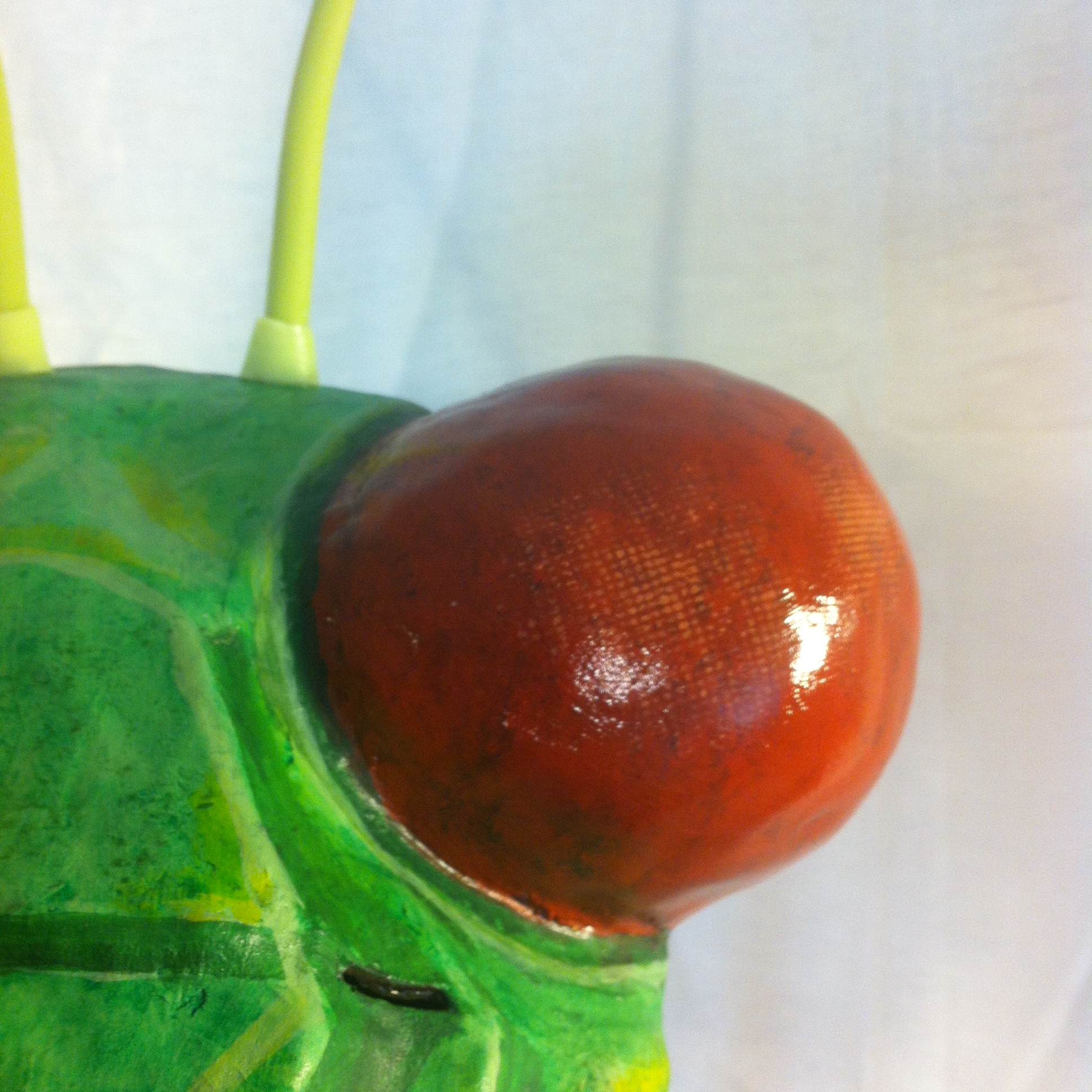
For the eyes on this version, I began with a sponge technique to break up the flatness of the red. On top of that, I used a stencil technique to suggest the segmentation of the eyes.
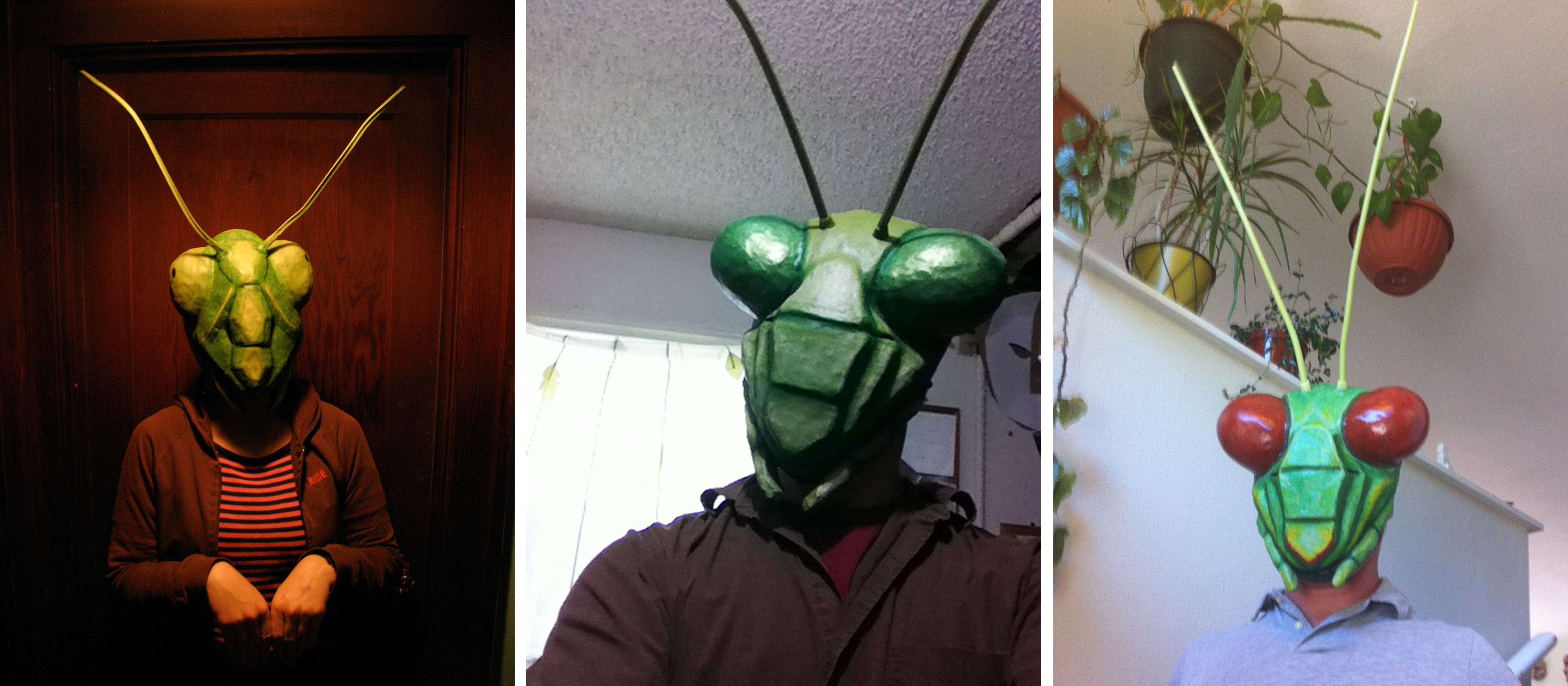
I’ve learned great things each time about this he next time I work on this mask, I want to explore greater width. Here are all the versions so far:
Side by side
In this silhouette, the mask is almost three times as wide as the human head!
It’s taken a few months to organize and upload the photos from my trip to India, but I’m happy to report they are are ready! And good golly, there’s a lot of them. So a few options exist.
If you want the entire adventure, including all the work on Maya the musical and my subsequent travels to south India, follow this link.
If you want to see just the travels to south India, click here.
Inspired by the study of mythology by Joseph Campbell (a favorite of mine too!), as well as theatre creators Ariane Mnouchkine, Jacques Lecoq, Peter Brook, and Complicite, Professor Stephanie Roberts is leading an exciting collaboration between UMKC Theatre and the UMKC Conservatory IMP Ensemble.
The working title is The Epic Project. It is a three year endeavor to weave contemporary and classic stories into an epic narrative suited to our times. The actors have been devising for nearly two years already. I was invited to be a part of that exploration this last February.
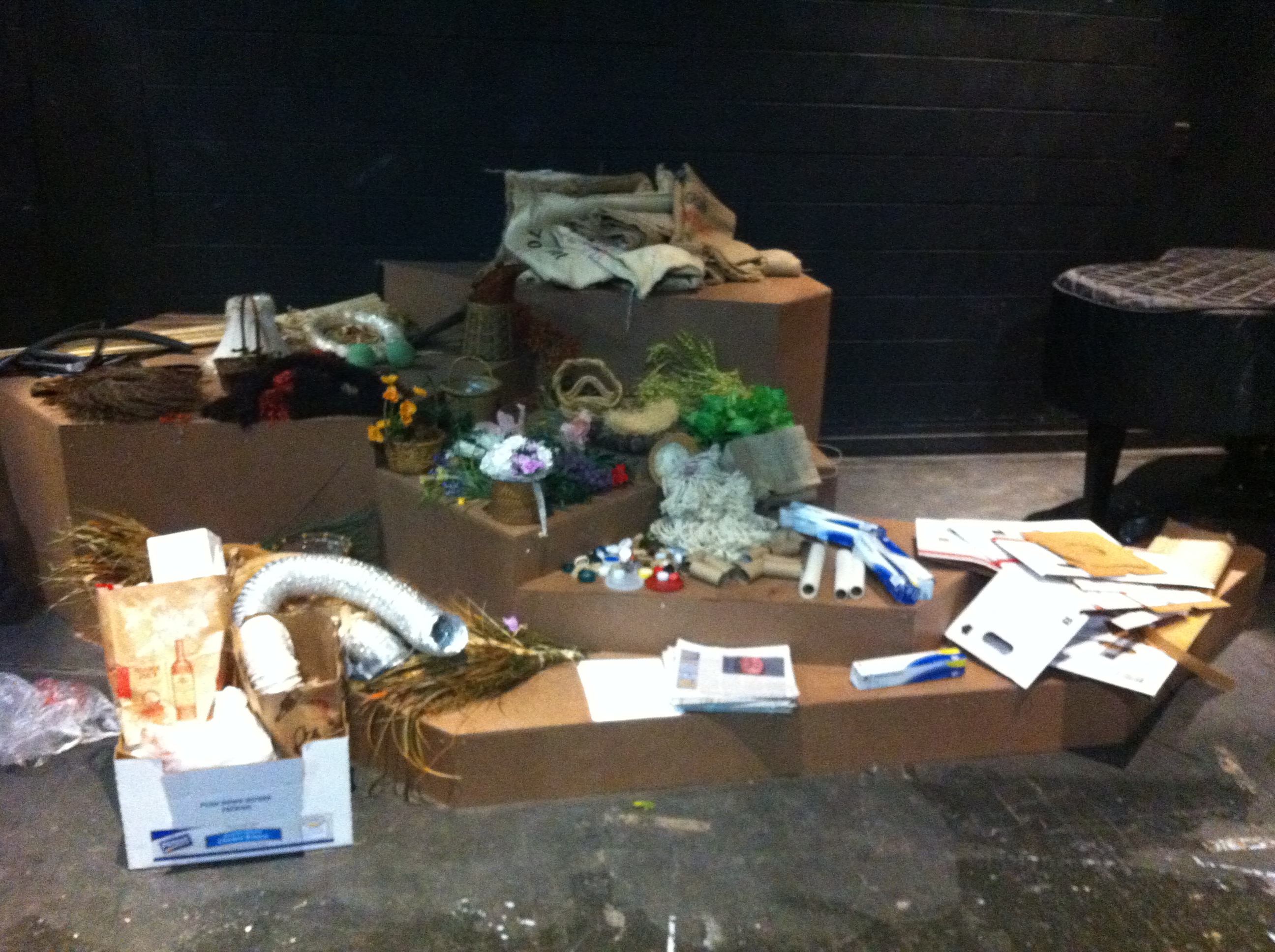
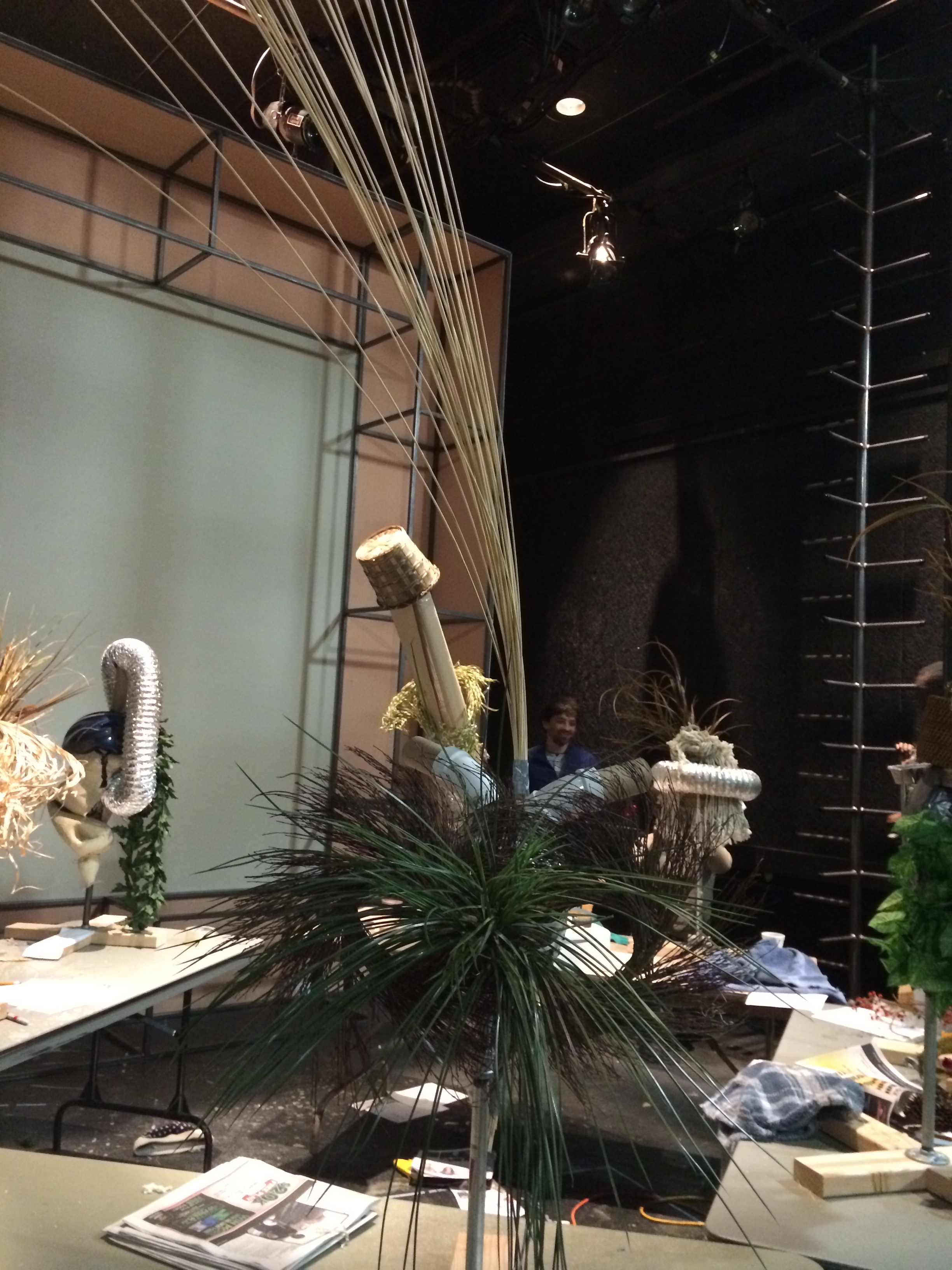
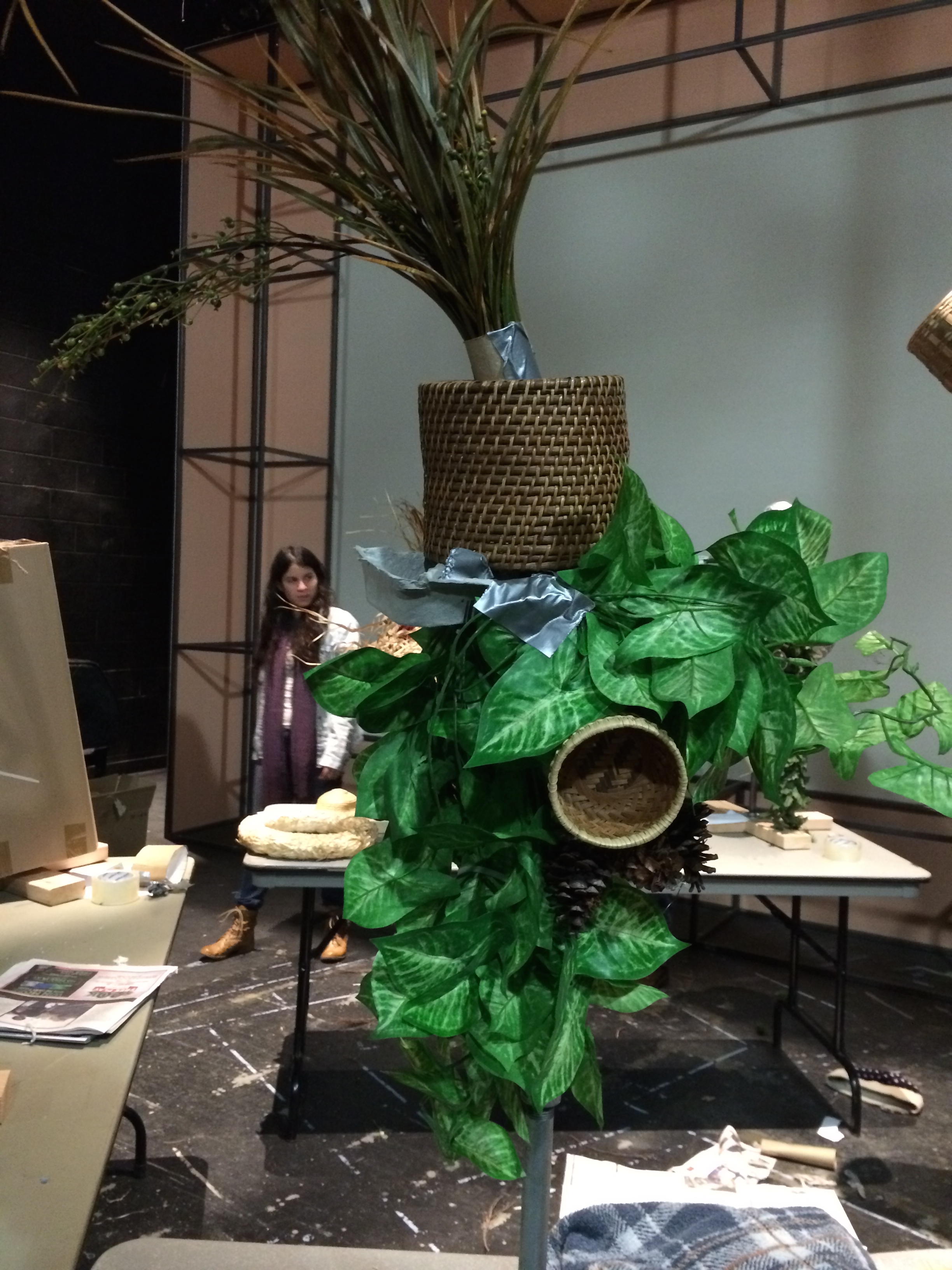
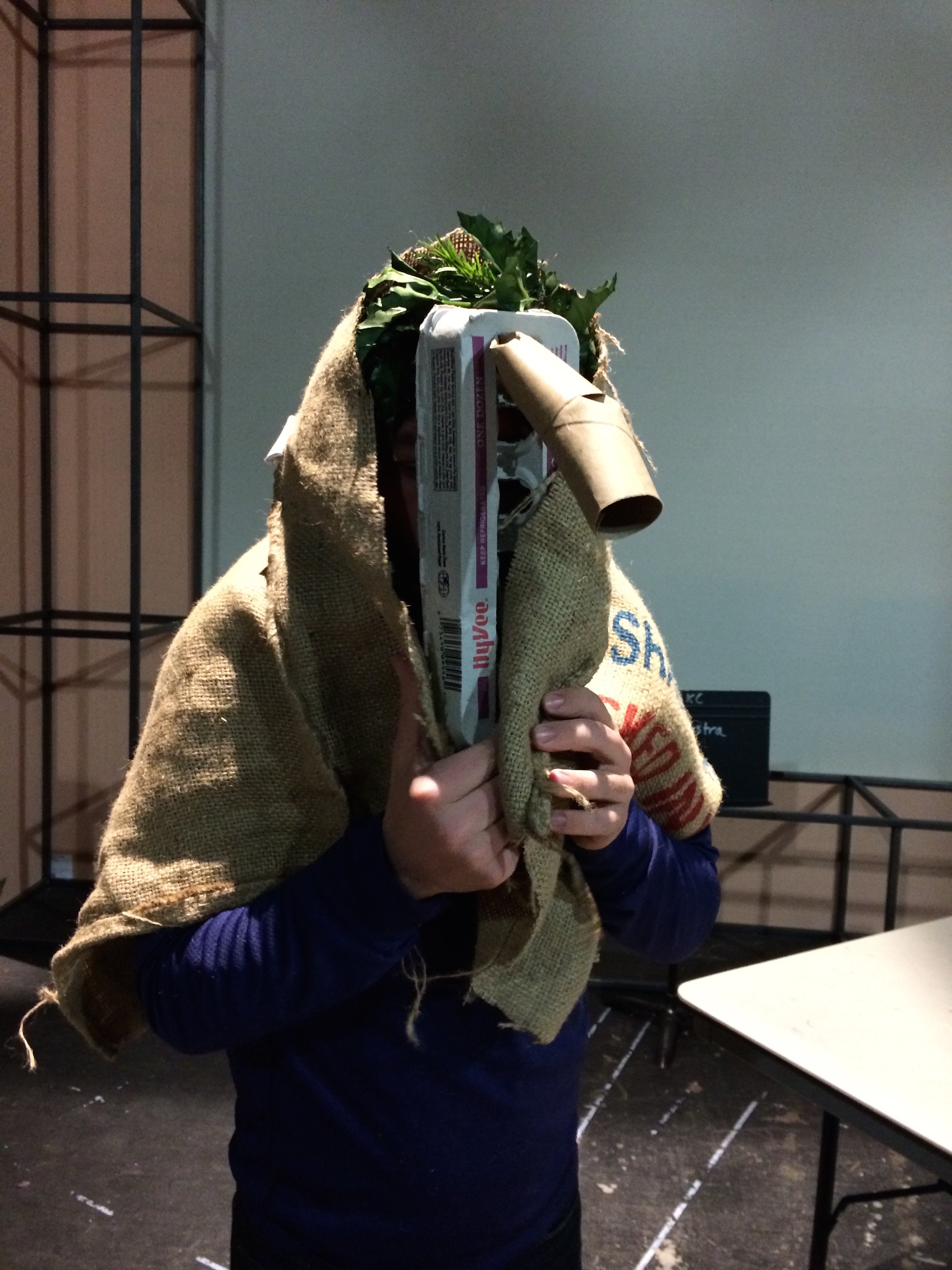
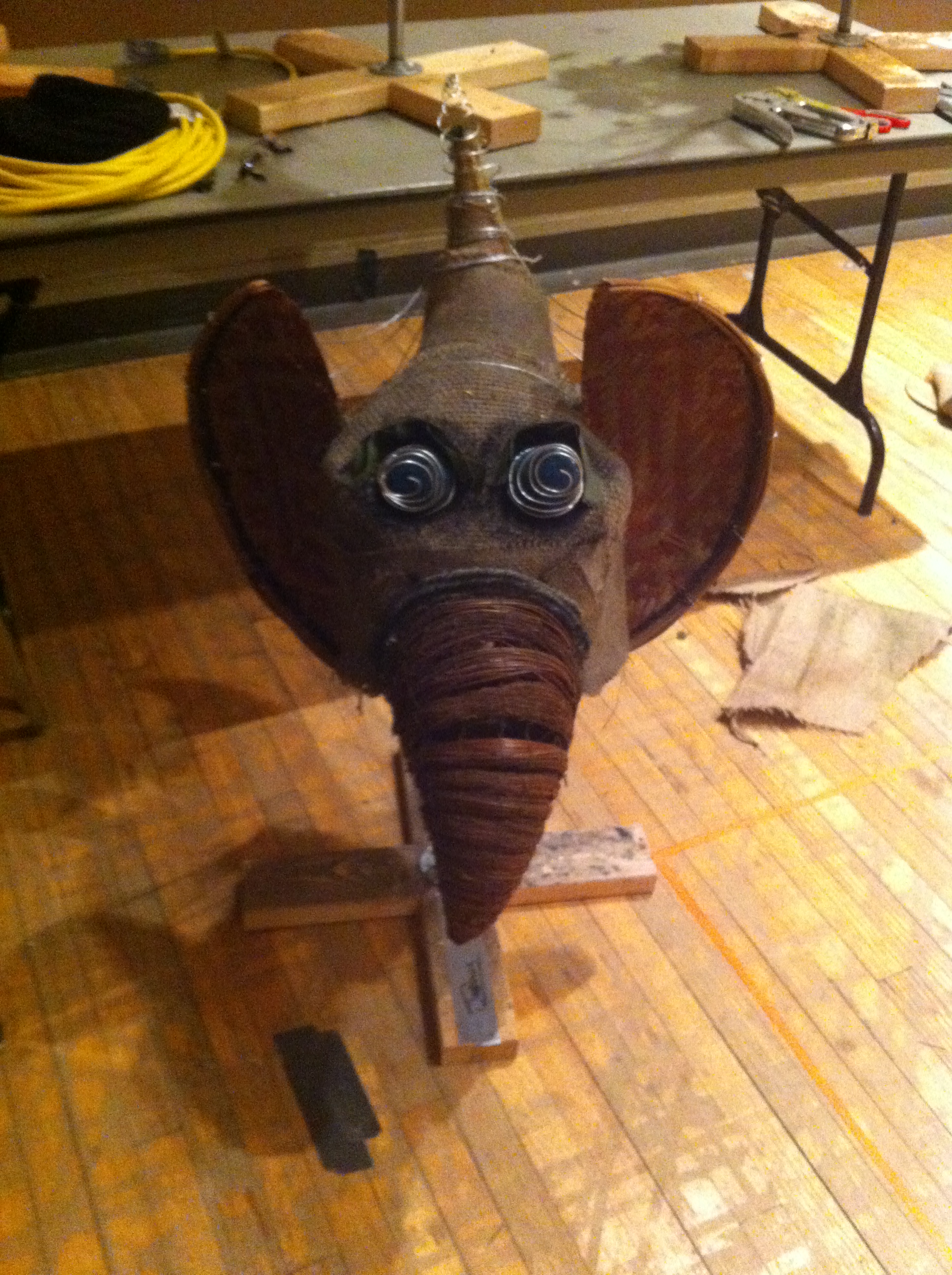
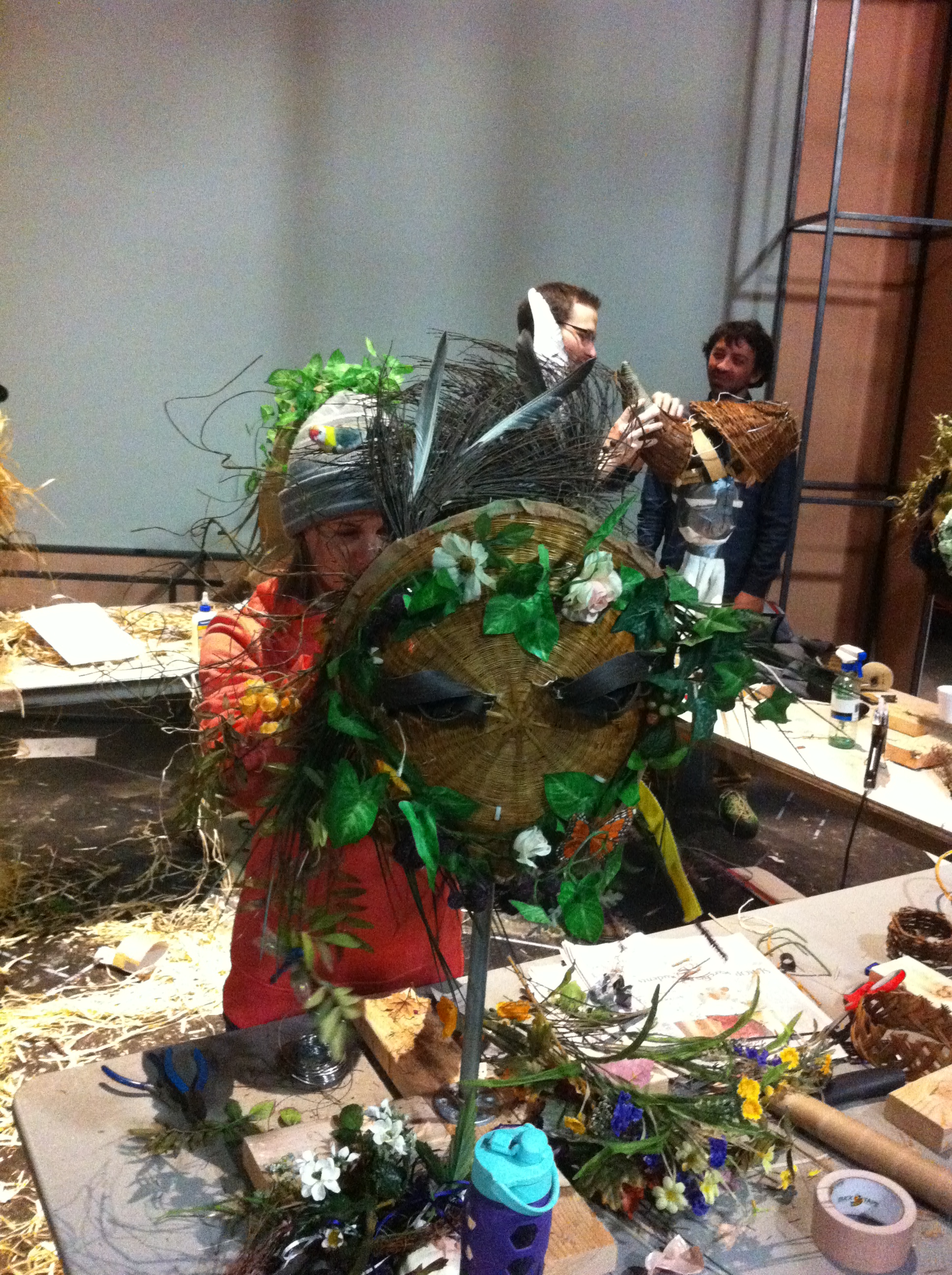
As a part of their exploration of character and archetype, I worked with the actors to create animal-spirit masks. The inspiration for this work came in part from old mask and mummer traditions from Europe and also from animal and spirit masks from around the world. I asked the students to engage with familiar objects and new materials as they uncovered the spirit of the animal within.
Enough chatter. Here are some pictures!
Initial experiments
Joshua uses a basket to create a mouth.
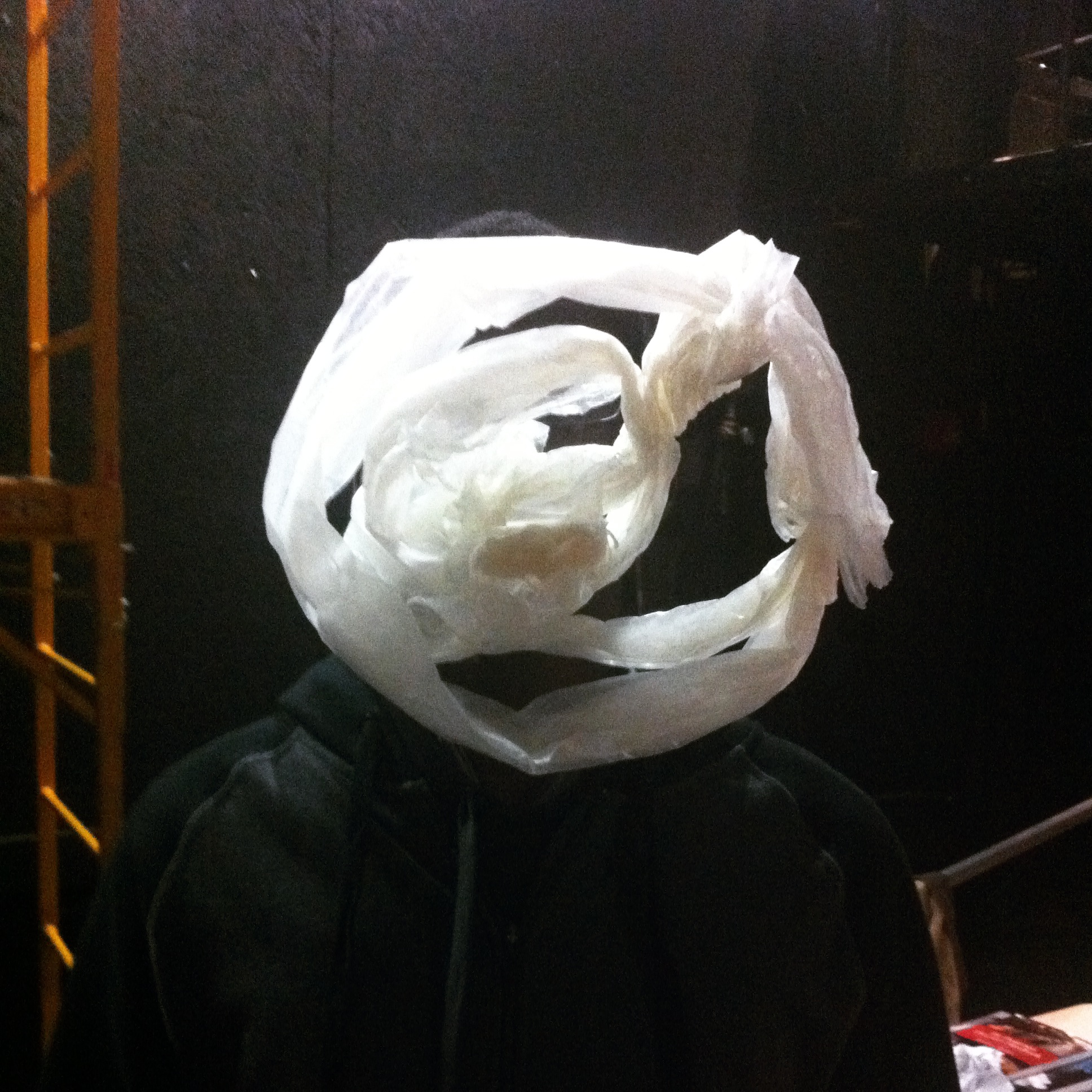
An experimental mask made by Edwin. It’s made of wax paper and captures the movement and essence of a different material.
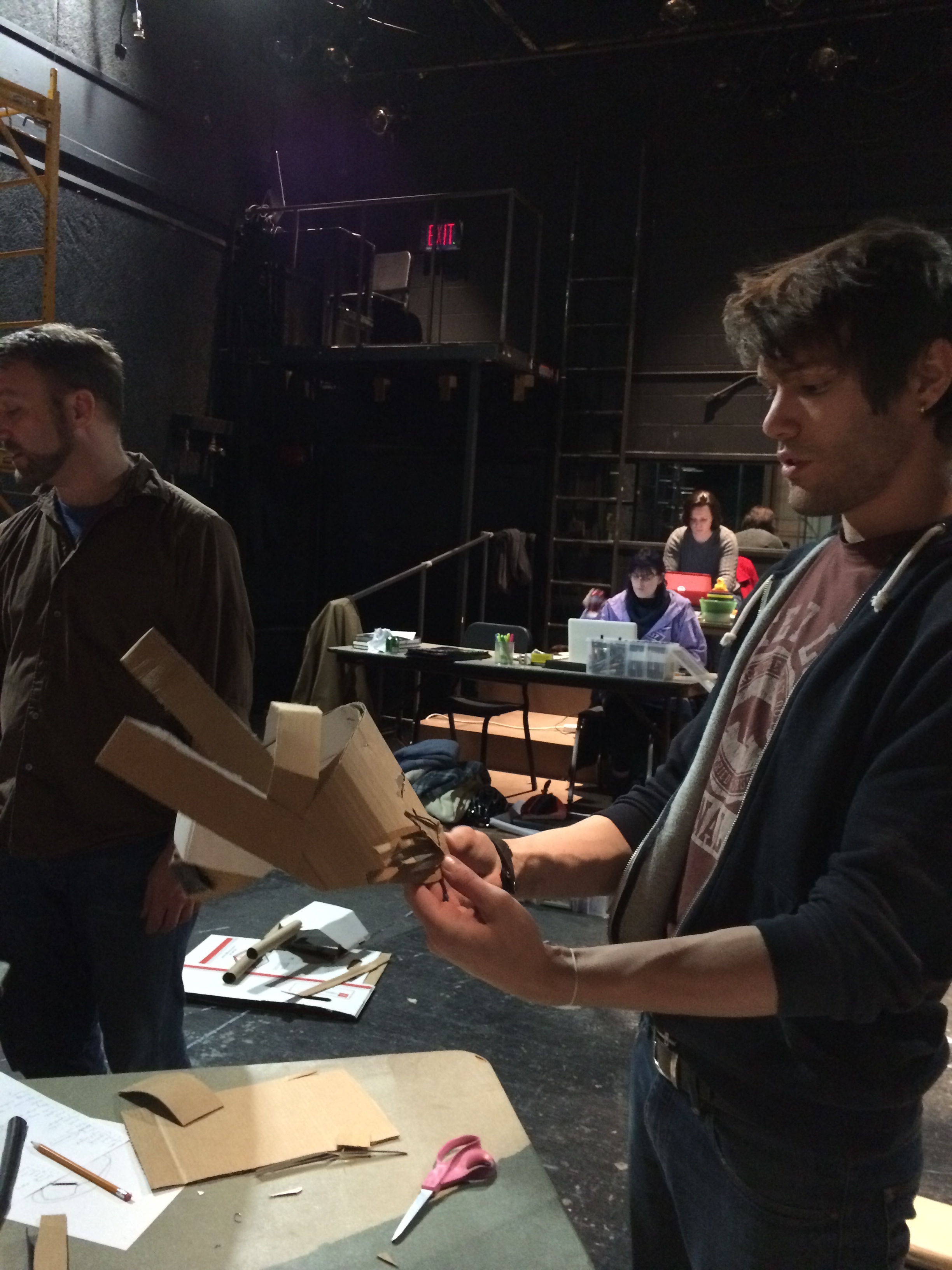
We then tried making animal masks using only one material: cardboard.
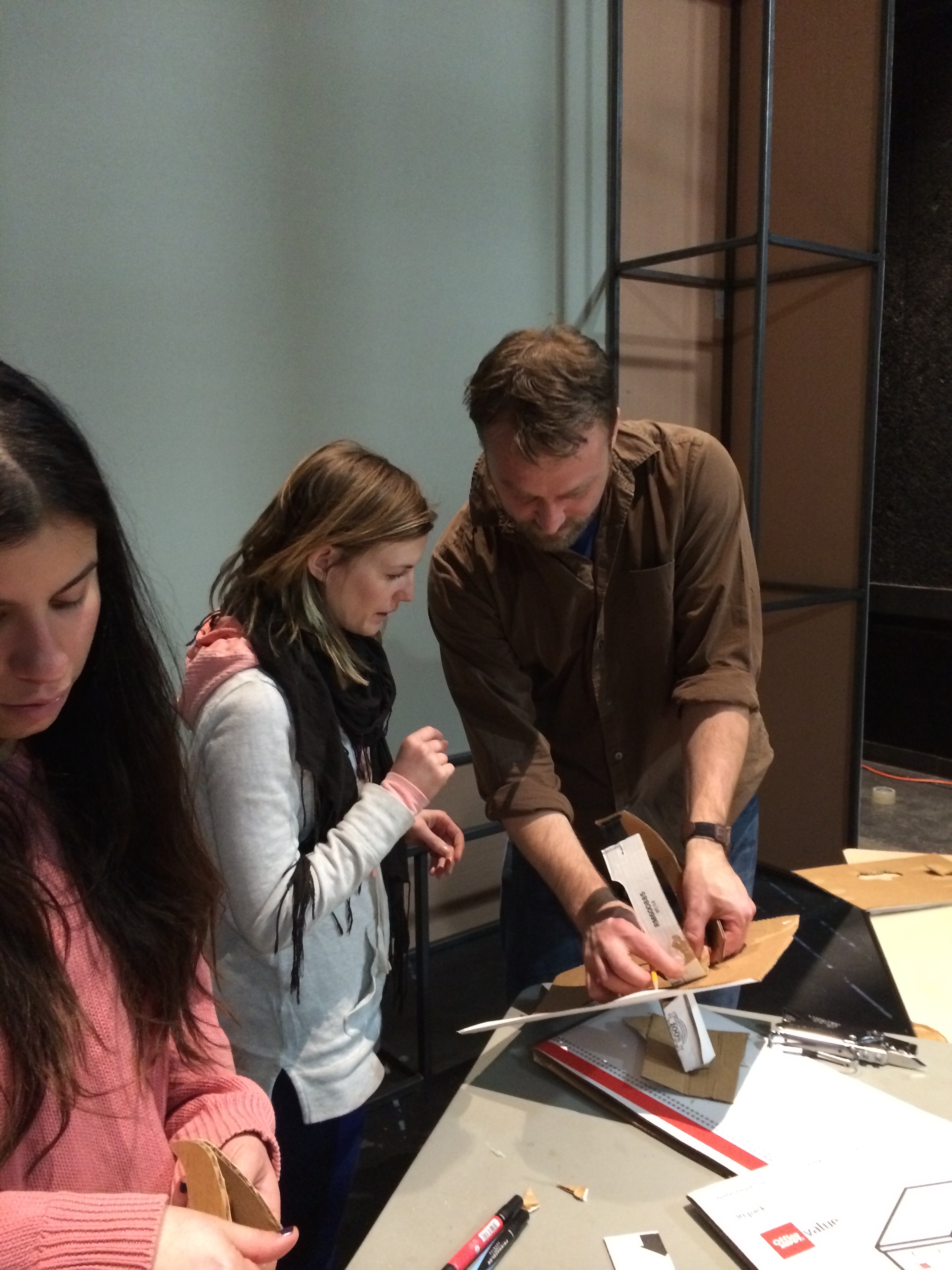
Making a mask not only requires choice of material, but constant check-ins along the way.
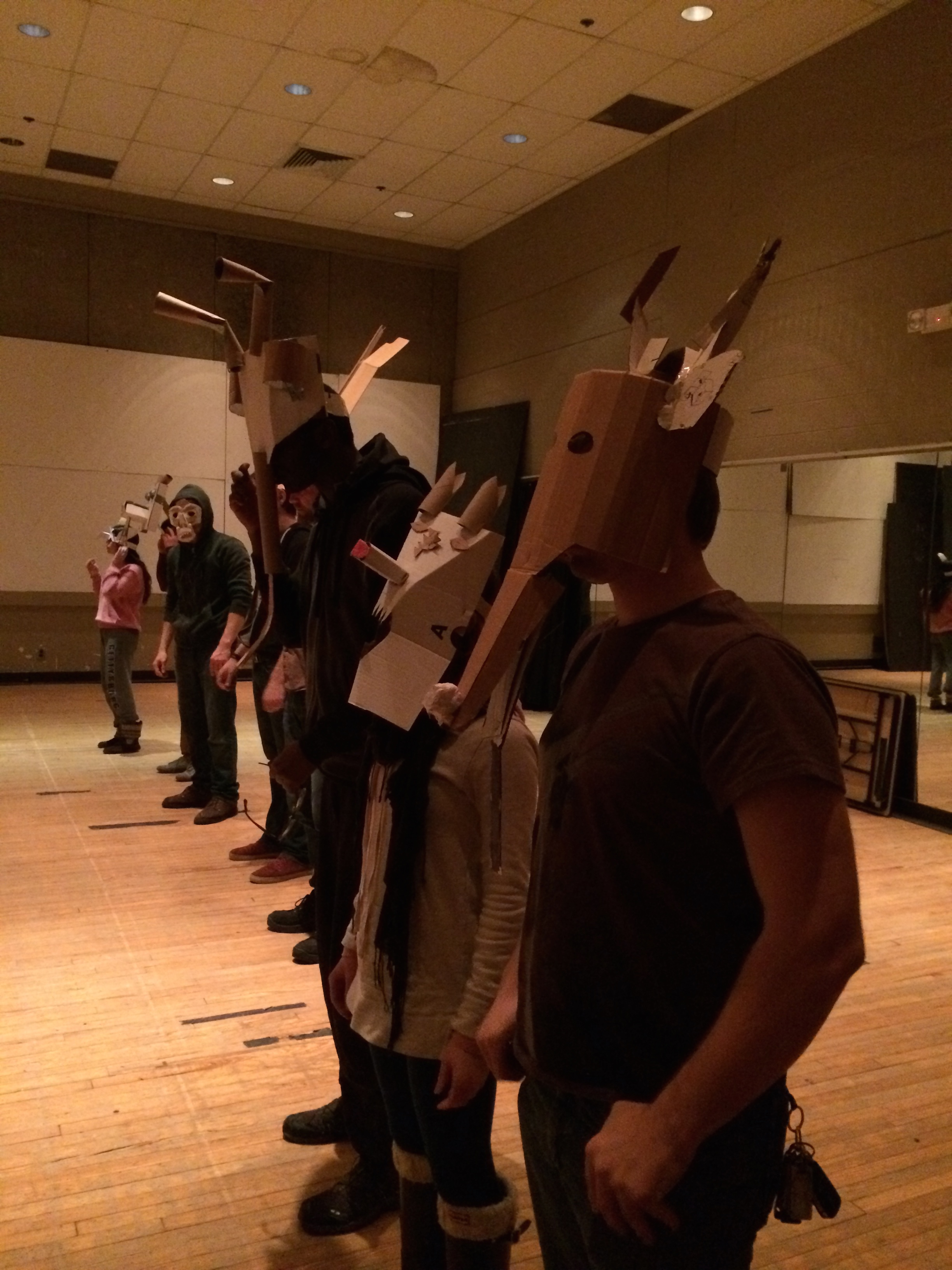
Masks aren’t complete until the performer’s body is added. We used this as a way to check in on our work as we built.
Digging further into materials
What we’re working with.
Uncovering the animal spirit
We did many experiments with materials and forms, then took what we learned and started making the mask for each actor.
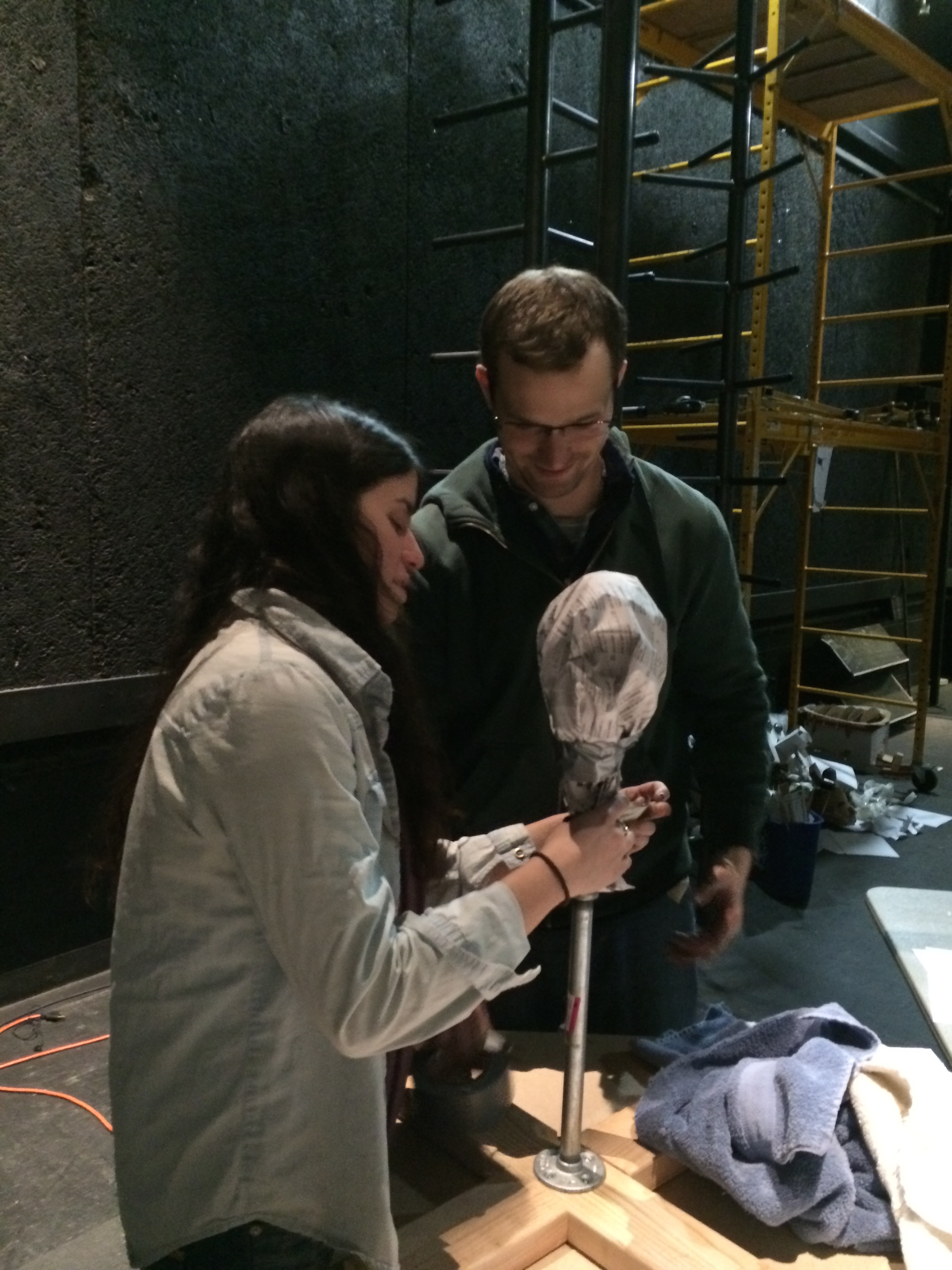
The actors made a ball of paper the size of their head and attached it to the armature stand. This helps them size the mask correctly.
On the second to last day of our process, Julie Denesha from KCUR came and interviewed some of the actors. Check out her amazing photos here.
Mariem/Mosquito Photo: Julie Denesha
See the work-in-action!
Come see the workshop performance in this phase of the Epic Project in Studio 116 at UMKC’s Performing Arts Center (4949 Cherry St.) Previews run from Friday Mar 6-8th and runs Mar 11-15th. Shows at 7:30 with the exception of Mar 15th at 2:00pm.
Seating is very limited so please reserve your FREE tix at 816-235-2782.
Over the course of the last three years, I’ve had the great pleasure to work with Many Hats Collaboration’s Jessica Wallenfels and Eric Nordin (and a slew of other talented artists) on the development of an original work of dance theater, The Snowstorm. It’s been a great journey, and I want to share a little of that process with you in this post.
Beginnings
Creating original work requires a lot of skills, in addition to having a vision for the show. Among these are communication, collaboration, being present, creative problem solving, flexibility, comfort with ambiguity, etc. The process was always a pleasure—largely due to the talents and leadership of Wallenfels and Nordin—and it also took us in many directions.
I played a couple of roles throughout. Initially, I worked as an actor to help develop physical vocabulary for some of the key scenes. Through this process, Wallenfels was able to get a sense of what it would take to tell a clear story through movement set against the music of Rachmaninoff.
The Hawk, the Bear, and the Hen in rehearsal for the 2013 workshop at Portland Actors Conservatory. One of these actors was eventually cast in the 2015 production.
A year or so later, after many such experiments, a short evening of scenes was presented. One of the things we were trying to determine was if masks were a good fit for the show. Since it was just a test, we used placeholder masks that approximated the feeling of each of the masked characters.
We found we weren’t sure if masks were the best solution. Early in 2014, Jessica and I met to discuss our thoughts on the approach. I had just returned from Bali—and Jessica had been there herself, years earlier—so we thought we could also explore shadow puppets.
Fox tries to free the Hen
Shadow Bear!
Hawk of Darkness
I decided to create a shadow puppet show that used the same two pieces of music in the first scene of The Snowstorm. I performed it with a second puppeteer for a Puppet Slam produced by Beady Little Eyes last spring. After more discussion, we decided that the shadows would likely be too difficult to see clearly in the thrust stage at the CoHo. We held on to the possibility of using both masks and puppets as we began to meet with the entire production team.
Though I didn’t pursue this further, the final wolf mask does have some textural similarity.
The surface treatment is borrowed from various Russian folk patterns.
Fabric was one material I considered using for the mask.
In an early iteration, all the masks were face masks.
Researching the various animals in the story came next. Through our meetings, we had decided to go with masks. I tried to find a design concept that would serve the multiple needs of this particular production: a fantastical quality, a handmade look, and an ease of movement were among these needs. As I was working in India, I would make sketches and email them back to the production team so that all of our designs could work well together. Nothing was feeling like it hit the mark, so I tried to think of other ways to solve the problem. Finally, drawing on my recent experiences making a peacock mask for Maya, I proposed using a kind of helmet mask for the show. This option promised an interesting transformation onstage and seemed exciting to build.
The actor sees through a stylized opening in the mask.
The actor puts the mask on like a hat.
Preparing for rehearsal
Typically, I prefer to provide the finished mask at first rehearsal. I feel this way because it allows the actors (who may have no experience performing with masks) to get used to the different performance style they will need to employ. With this show, we knew we wanted to have a little more flexibility and room for discovery. So with the design we thought we wanted in mind, I generated some rehearsal masks to give the actors a sense of what it would mean to perform in the masks.
Hawk’s rehearsal piece gave us both a way to test the scale of the mask.
I made these cartooned masks from cardboard and bike tire…
… and a simple head ring.
With the information from the rehearsal room, I was soon ready to sculpt. The discoveries did not really end there, which is really the fun of the whole thing!
Weighing options on the sculpture of the Wolf.
Hawk gets his glare on.
I used different colors of paper maché to help the actors see the image of the character before it was painted—but we liked the handmade quality so much we kept it!
For the Wolf, I used a more varied color palette and texture.
Rehearsing with the real masks provided lots of information about lighting, movement, and comfort. This is a lot of foam, which I later disguised with black broadcloth.
The Final Masks
The actors brought the masks to life beautifully! (Shadows still appear in the play, even though they are not the primary element. Knowing the process, it’s interesting to me to see how all of the different artistic impulses eventually found their place in the show.) Here are a few shots from the performance.
Beth Thompson as Bear. Photo: John Rudoff
Eric Nordin (pianist) and Jamie Rea (Swan). Photo: Brud Giles
(L to R): Beth Thompson as Bear, Elisha Henig as Fox, Brian Demar Jones as Hawk, and Kira Batcheller as Hen.