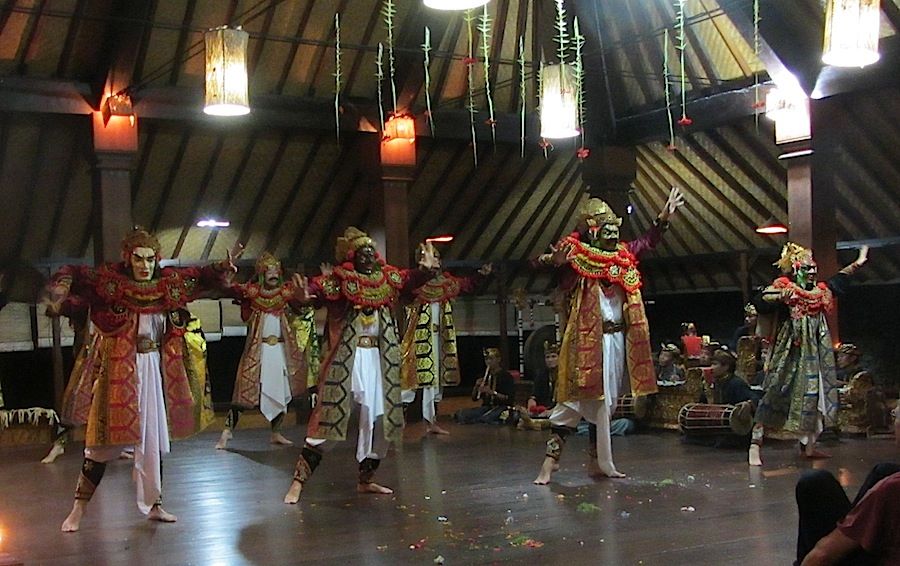
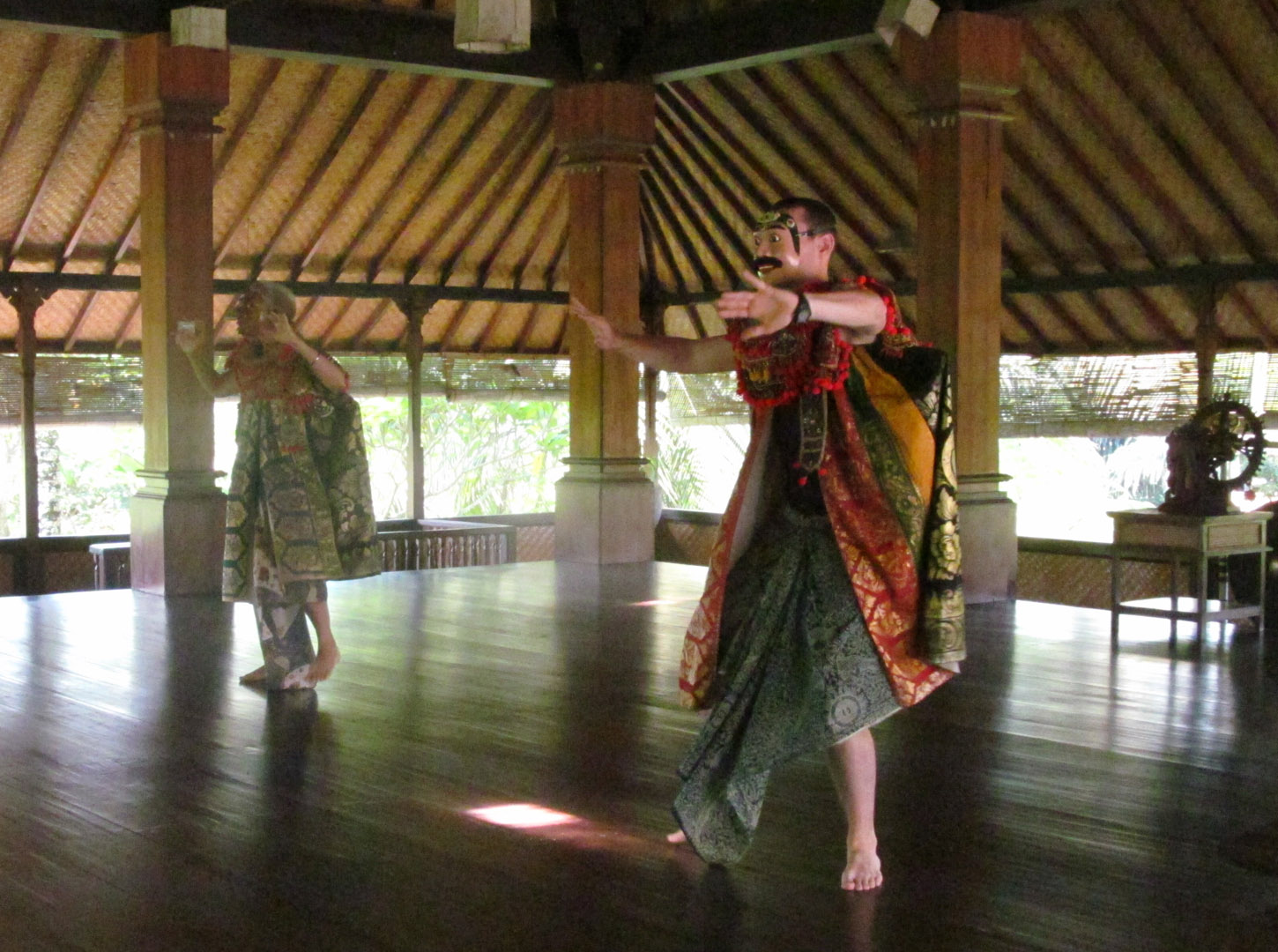
I’ve been back a month now! And I haven’t been dancing nearly enough. Here are some moments that take me back.
Topeng
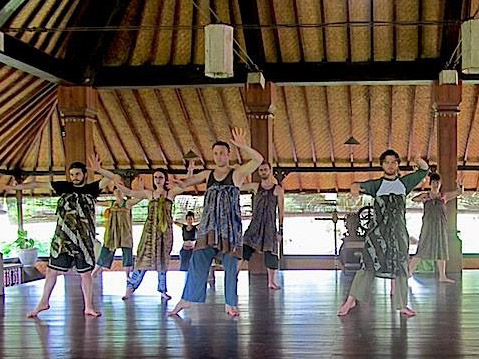
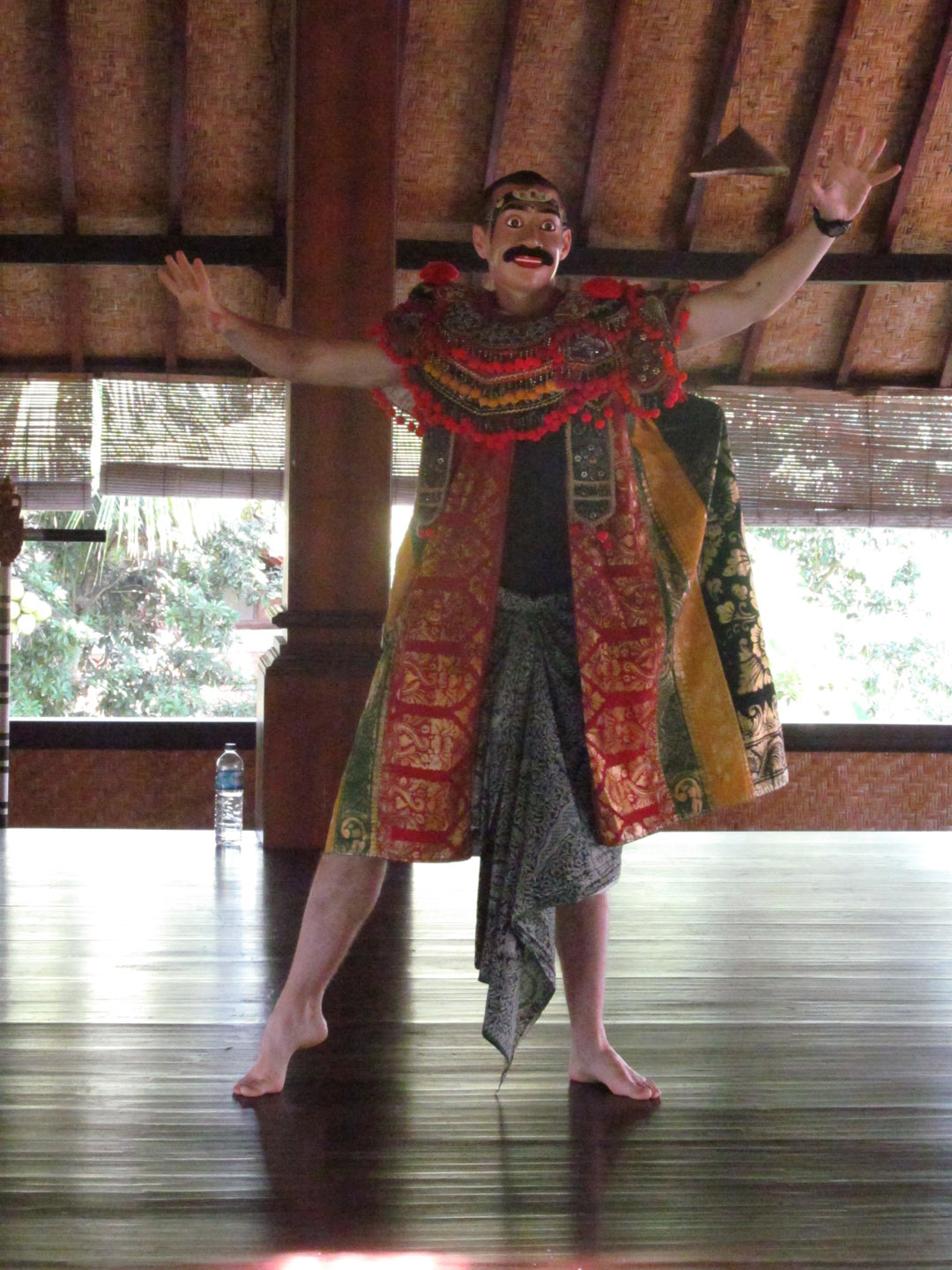
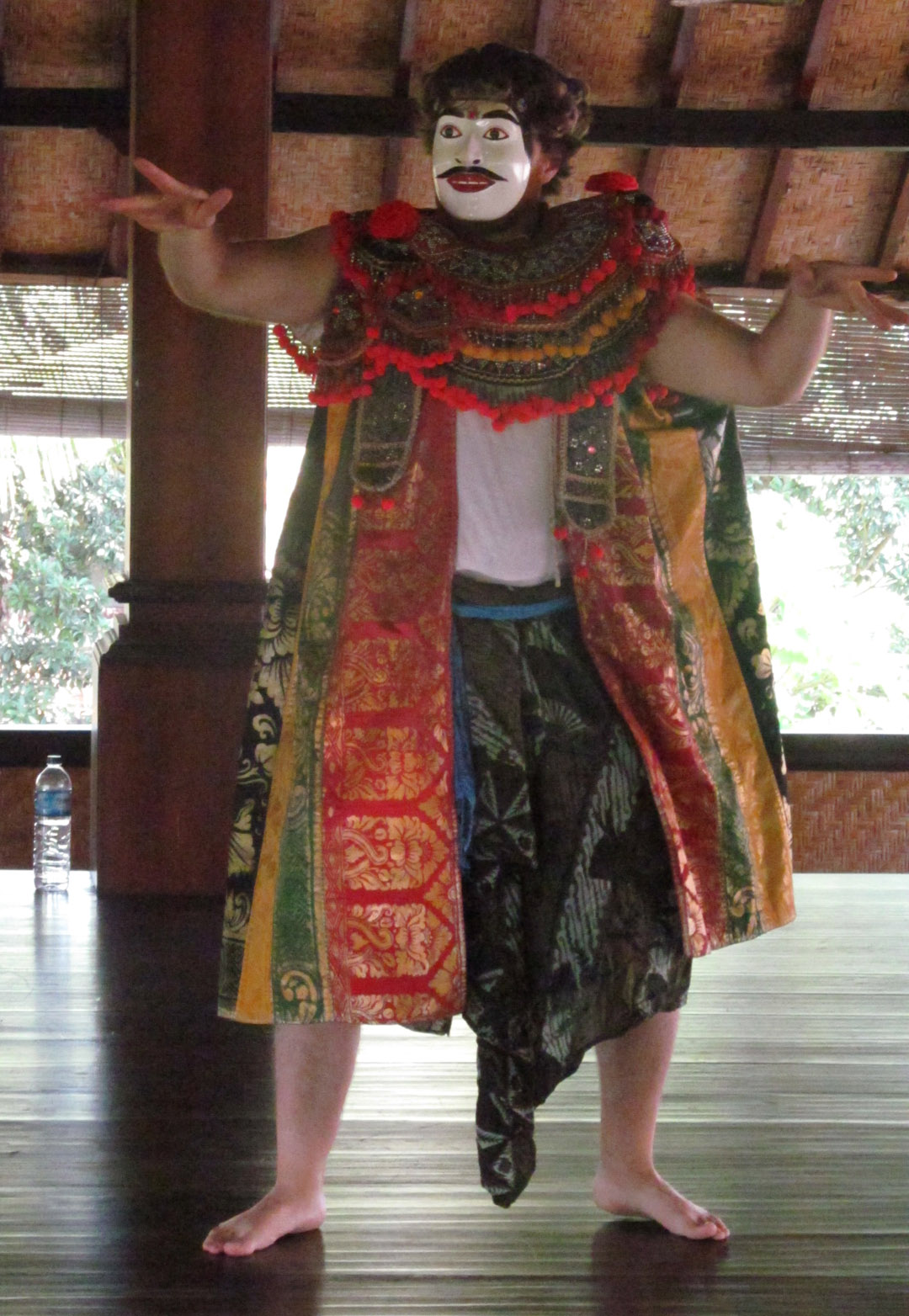
In dance class, we tied our sarongs high to simulate the costume we would eventually wear.One of the more genial masks of the ones we used in classAnother variation of the keras mask.
After a few weeks of study, we started wearing a mask and the basic parts of the costume in class. Both really change the way you move.
We began each class with a review as a whole, then dancing in pairs for greater detail work.
The costume frames the mask—which is typically carved slightly smaller than a face—in a way such that the arms and shoulders must be held high for it to play correctly. It feels odd at first, but it’s much easier to get a feeling for the choreography when observing others use the mask and costume pieces.
Some of the costume pieces—the wig, the hat, and the flowers by the ears—we used for the first time before performing for the public. It can be a little disorienting to add things at the last minute, but that’s how it goes. Below is a video of our final dance performance. It should give you a sense of what we were doing. It should be noted that normally the dance is actually done solo, and the music follows the dancer. Conversely, we danced in a group, and were attempting to follow the music. We got it mostly right. 🙂
(Psst! I’m on the right.)
Kecak
On that night, we ended with our kecak performance. There are six interlocking rhythms that form the majority of the chant (we each learned one of the six), as well as a bit of singing. Originally, the kecak was done as a part of a trance ceremony. Since the artistic intervention of Walter Spies in the 1920s, this chant includes the story of the Ramayana when performed for tourists.
The video below is a section toward the beginning of the piece, so unfortunately you don’t get to see the exciting part we chase each other with fire …which we used for the first time during our actual performance. Can you say “trust exercise”?
This trip was made possible in part by a grant from the Regional Arts & Culture Council.
As promised, more photos! Click on the link above to see all the photos in the blog and many, many more. It is such a pleasure to share them with you, and to give a little visual context for all I’ve been writing about.
This trip was done through a program of Dell’Arte International. It was made possible in part by funding from the Regional Arts and Culture Council.
Photos from the Setia Darma House of Masks & Puppets
Here are my photos from our visit to the mask and puppet museum near the village of Mas in Bali. There are many masks from major Balinese performance traditions of Calonarang, Topeng, and Wayang Wong included. There were also masks from other Indonesian isles and many other countries. I’ve included text from the museum placards (or at least the spirit of it) in the descriptions for each photo.
Enjoy! Full photo album from the trip forthcoming!
Your friendly neighborhood mask maker,
Tony
This trip was made possible in part by a grant from the Regional Arts & Culture Council.
Wearing one of I.B. Anom’s creations the first week in Bali.
Re-entry is interesting. And by interesting, I mean full of surprises. Surprise is also, itself, interesting. And therefore surprise is…surprising.
I’m not just playing circular word games. Surprise, like accidents, cannot ever be fully predicted. For example, when thinking about my reactions to coming back to the US after studying abroad, I could see some likely outcomes, and was therefore relatively prepared for those. But re-entry is surprising (=interesting (=surprising)). No matter how much I might look ahead or prepare, there will always be something surprising, something I won’t see coming. Yet somehow I’m always surprised by the fact that I get surprised. And that’s interesting.
Melati Cottages, our home away from home. At the time this picture was taken, Portland was 66 degrees colder than Bali. But that was to be the least surprising change.
It was surprising to me to find the way in which the known parts of my life at home were feeling foreign. Suddenly awake and confused with jetlag at 4am, I looked at everything in my room. “This is mine. I chose these things. This is the way they look.” Somehow it felt all very faraway. Recognizable, yes; but the thread of connection was difficult to perceive.
Nyoman Setiawan and I at the last group carving class in the Pondok Pekak Learning Center in Ubud.
A few days have passed, and the feeling has largely diminished. And as my home reality takes precedence, I want to record a list of sights and impressions from my trip before they, too, seem distant and difficult to connect with.
Sights and Sites
The second room I enjoyed at Melati Cottages. Aren’t mosquito nets ineffably romantic?
(These are in no particular order)
° Sidewalks are segmented, and some stones have metal handles. The walkway often has several stones which have fallen in, revealing the water channels beneath. These channels are all connected to each other.
Lucy and I in temple dress at a ceremony in Batuan.
° Sarongs, sarongs, sarongs! They are commonly sold in printed, batik, or ikat fabrics.
° Shops that are all selling mostly the same things, right next to each other. Bargaining is the way things are done. “I give you good price, for luck.” Keep your sense of humor.
School children in their uniforms are frequently seen on motorbikes or waiting for the bemo. Very sharp looking crowd.Amazing statuary at major intersections is very popular. I vote no billboards, more huge sculpture, America.
° The lack of idle chatter about first world problems, celebrities, and so on. How refreshing!
Tempe, a favorite of mine for many years, is an Indonesian food that is a fermented soybean cake. As pictured here, it is also battered and fried and served with several types of spicy sambal.
This is not to say I didn’t witness some very odd Javanese game shows and soap operas on mute in the central room at the hotel.
° Coconut, banana, papaya, and jackfruit trees are widespread. There was even a mangosteen tree on the grounds of the hotel! Thankfully durian were more rare.
Daily breakfast at the hotel included fresh fruit (papaya, pineapple, watermelon, lime), some sort of eggs, and ALWAYS banana crepes.
° The frequent appearance of the words “spa” and “villa.” These words are replacing the words “rice paddies” with increasing frequency.
° Bottles of petrol for sale on the side of the road. You can buy in either kecil (small) or besar (large). The large fills your motor scooter tank, and costs 1400 rupiah. That’s about $1.
° Very noticeable is the red and grey and black coloration of so many housing compounds and temples.
Much is exposed to the elements in Bali. Many buildings and restaurants and shops have few external walls, if any.
° I enjoyed the moments where I started to understand what I was seeing. Just the beginning of understanding really, like when you’re learning a language, and every so often you recognize a word instead of only hearing sounds. The positions of the golden statues I’d seen along the road when I arrived were suddenly recognizable choreography. When looking at a painting or temple figure, I could recognize a character or sometimes a part of the story of the Mahabharata or Ramayana. What was aesthetic appreciation at first now carries more context and has more meaning.
Rice paddies along Jalan Bisma.
° Black and white checkered sarongs wrapped around banyan trees, signifying they have a spirit and are protected. These sarongs also sometimes appear on certain statues. Balinese religion is a fascinating mix of Buddhism, Hinduism, and animism. Good and evil are both acknowledged as forces in the world—our purpose is to keep them in balance.
The family temple, as seen from above, of my mask carving teacher. Note the Moe (of Larry, Curly, and…) hairstyle of the small towers.Dewi Suraswati, the goddess of learning and the arts. Careful observers will note that in this rendition, a toothbrush is in the mouth of the goose. Much debate among international scholars about the relevance of said toothbrush doubtless to follow.Architectural detail. Much of the construction is cinder block. Scaffolding is done with bamboo.
° Offerings are everywhere. Not just on the front porch, or in a little box at the corner of a building. Even in the middle of the supermarket, there are offerings.
° Wayan Wija talking to us about his role as a dalang (puppeteer). The dalang is also a sort of a priest and philosopher. He often deals in ancient stories that bring to life questions of philosophy, while also providing something for the eyes to enjoy. Wija says that even in Bali, so many now are filled up with material concerns, few have room in them for philosophy.
I.W. Wija lets us experiment with this amazing expressive shadow puppets at his house in Ubud. (Photo by Yavni Bar-Yam)At least I looked completely inconspicuous and at ease at all times.
° Parisawata tour buses choke the small, winding back roads… Chinese and Australian tourists wander in downtown Ubud… white people look hot and uncomfortable while some Balinese are wearing jackets, because it’s cold to them.
° The smell of cempaka incense.
° Frogs performing their own version of a kecak or a gamelan. All three—frogs, chant, and orchestra—produce interlocking sounds that are beautifully trance-like and transporting. But how do the frogs all know to cease at same time?
Nyoman shows off his dancing hands. Carvers are also dancers.
° Our mask carving teacher talked to us about the meaning of the progression of the characters in the one-man topeng pajegang. The progression of the story mirrors the the entire life of a person. The dancer moves from the rough path of youth with strong will and body (topeng keras) to the strength of mind and experience (topeng tua) to the enrichment of life gained from sharing experience (topeng penasar) to the leadership of others (topeng dalem) and finally to success and prosperity (topeng sida karya).
The large market is Ubud is a confusing trail of stalls spanning several buildings and multiple levels. FYI the scent does not improve as you descend.Snake deities called naga line the staircases of this temple at Goa Lawah.Shadow puppets! They are painted because they are sometimes used in daylight. Also, the paint design helps remind the puppeteer of the feeling of the character.
This trip was made possible in part by a professional development grant from the Regional Arts and Culture Council.
At left, how the camera captured Mt. Agung on my last morning walk. However, it was much more visible to the naked eye. At right, a highly altered photograph reveals the outline of the peak. Tricksy mountain.
I write this blog from the airport as I wait for my flight to Portland to board. I wanted to catch you all up on the masks I’ve been making in Bali. In my last post, you saw the old man bondres I completed. My teacher pushed me to start two more, so that I could get the hang of beginning from a simple block of wood.
This is a block of pule wood. It is a bit harder than balsa, but softer than pine. I’m excited to see which woods I might work on in the NW.
Mask 2: Gajah Mada
For the second mask, I decided to make one that could be used in the dance we were learning. I sketched a version of the prime minister that I wanted to create. He’s a warrior, and the first to dance in the topeng.
Evening out the block of wood in the afternoon.After the first rough blocking, we saw our dance teacher Gustu perform his version of this character. I was inspired by the ferocity of expression in his mask. My sketch changed a bit after that.
After I showed my sketch to my teacher, he said it was a “Gajah Mada” character. I was confused, as gajah means elephant. (Remember when I went to the Goa Gajah cave? That was fun.) He said it was more of a metaphor, and refers the feeling of strength of the character.
I am taking this one home to Portland to complete the sanding and painting. This mask will have the eyes painted on, and the dancer sees through the shadow-like slit beneath the eye.This is me performing the topeng keras dance on our performance night. Imagine it danced to firelight if you can. The mask was loaned by our dance teacher, and is very powerful.
Mask 3: The Gentle Giant
Halfway there!
For my final mask I was to start in Bali, I knew I wanted something a little coarser and with a moving jaw.
Chiseling out the teeth. As I look through his eyes, I realized he a little more dim in the bulb than I originally thought.
While working on this mask, Pak Nyoman stood back and let me figure things out as much as he could, which I appreciated. It can be difficult to willingly dive in to your own inevitable mistakes, but it’s much more worthwhile.
And it’s also a bit slower going! I elected to take a couple of extra classes to get some more guidance. It was fun to work one on one. We got to talk about mask styles from around the world. Nyoman also mentioned that although he is happy to carve traditional Balinese characters, he also welcomes the challenge of other styles, traditional or modern.
But then again, who wouldn’t? It’s part of the artist’s work and the human condition to follow inspiration and find those things that feed your soul.
Back in San Francisco, my friend Bird models the latest mask.
Though I am en route to Portland, fear not, faithful readers! I will be continuing my blog into the future. There are still some things about Bali to write about, and there will always be more masks I’d love to share with you!
This trip was made possible in part by a grant from the Regional Arts & Culture Council.